


 Nature
 PUBLISHED




The earthquake that killed tens of thousands of people and led to the Fukushima nuclear shutdown was amplified by a soft layer of slippery clay, according to a new study. The layer is only around 25-30 meters (80-100 feet) thick with far more material above it, and the rupture was limited to parts of this. It is hoped the discovery could help us prepare for, and maybe one day prevent, similar events.
We know that large earthquakes are the product of tectonic plates trying to slide past each other, with pressure building up until it is released in a single catastrophic moment. However, there are still a great many questions about why some quakes are so much stronger than others. The 2011 earthquake beneath the Pacific Ocean that unleashed a tsunami and changed the future of nuclear power was the fourth most powerful since we have had the capacity to measure such things.
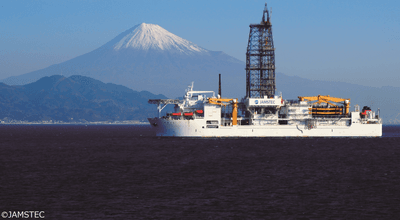
In an effort to understand why this was the case, a team of geologists sailed the drilling vessel Chikyu to the waters above the Japan Trench in 2024 and took core samples where the plates meet, setting the Guinness World Record for the deepest scientific ocean drilling ever conducted in doing so. China claims its ship Meng Xiang can drill even further down, but that has yet to be verified.
Analysis of these samples indicates the rupture took place in a layer of clay almost 8,000 meters (26,200 feet) beneath sea level, with hundreds of meters of rock and mud above. Yet the layer was actually thinner than the displacement caused by the earthquake.
“This work helps explain why the 2011 earthquake behaved so differently from what many of our models predicted,” said Associate Professor Ron Hackney of the Australian National University in a statement. In previous large earthquakes, the biggest movement occurred where the plate boundary was deepest, and models were built around this. In this case, however, the largest slip was where the encounter between the plates was shallowest.
Drilling was performed at the plate boundary in 2012, but a decade later, scientists decided the samples collected were insufficient to answer their questions, so a new mission was conducted.
The researchers concluded that movement is concentrated where sediments with very different physical properties are placed against each other.
The clay is composed of sediments deposited on the sea floor from the late Cretaceous until as recently as 20 million years ago.
The information could potentially help identify sites where earthquakes might become particularly dangerous. Much of the damage from the 2011 quake could have been prevented, but governments disagreed on how high sea walls needed to be.
“This clay-rich ancient mud formed from microscopic particles that slowly settled on the seafloor beneath the Pacific Ocean over time – a process that took place over 130 million years – as the Pacific tectonic plate slowly moved west to ultimately be forced under Japan,” Hackney said. “The fault zone formed in that weak layer of clay as those sediments slowly slid under Japan, moving roughly 10 centimetres [3.9 inches] a year. Given that the weak clay layer is sandwiched between stronger layers of rock above and below, the clay acted like a natural ‘tear line’ that caused the fault to form within that layer of clay.”
Stress within the fault zone had been building up for centuries, so there was far more energy to release than at a location where earthquakes are more frequent. That alone, however, does not account for the scale of the quake. The weakness of the clay also mattered, because it meant there was less resistance to the movement once the break came.
“The rupture plane was just a centimetre [0.4 inches] or so thick, yet it allowed between 50 and 70 meters [164 and 230 feet] of movement on the fault and caused the seafloor off Japan to rise abruptly by several metres during the earthquake,” Hackney said.
The work would be most significant if it turns out that similar conditions contributed to other exceptionally large quakes. “There are indications that the sediments being drawn towards and under Sumatra may also contain a weak clay layer, which suggests that the giant 2004 Boxing Day tsunami may be linked to similar fault characteristics. Although we can’t be sure without extracting and analysing core samples directly from that fault,” Hackney said.
A documentary about the earthquake and the quest to explain it follows the drilling expedition.
The study is published in Science.




 1
1