Nature
 PUBLISHED





At 11:25 am local time on July 30, one of the strongest earthquakes ever hit the Kamchatka Peninsula, in eastern Russia. The quake had a reported magnitude of 8.8, making it tied for the sixth strongest on record. Two stronger ones were the 2004 Indian Ocean quake that hit Sumatra and the 2011 Tōhoku quake, both of which caused devastating tsunamis.
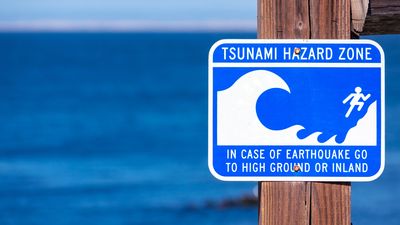
This new quake also caused tsunami waves across the Pacific, triggering the warning system on islands and coasts alike, from Alaska to Hawai'i, across Japan, South America, and all the Polynesian nations. Most of the warnings have now been downgraded, following the waves passing through. Millions of people were evacuated or had to find shelter away from the coast in many countries. Two million people moved away from the coast in Japan alone, as the country is only a few thousand kilometers from the quake epicenter.
Waves of up to 4 meters (13 feet) were reported in the Russian town of Severo-Kurilsk, about 550 kilometers (350 miles) from the quake’s source. Shorter waves have been reported across the Pacific. Currently, there are no reported casualties from the quake or the tsunami, showing that the warning system (part of which in the US has been targeted by the Trump administration cuts) is fundamental to keeping people safe.
The quake is one of the many that happen along the Pacific Ring of Fire, the 40,000-kilometer-long (24,854-mile) horseshoe-shaped tectonic belt around the Pacific Ocean. Seventy-five percent of all the world’s volcanic activity and 90 percent of its earthquakes, including all the previous strongest quakes, happened along this path.
The top 5 are all above 9 in terms of magnitude, so at least 1.5 times stronger than the one that happened today. Magnitude is a logarithmic scale, so every integer represents an increase of 10 times. The strongest on record, according to the US Geological Survey, was in 1960 in Biobío, Chile, reaching 9.5 – five times as strong as this one. Then there was the Alaska one of 1964, at 9.2, followed by Sumatra and Tōhoku at 9.1 each and another quake in Kamchatka back in 1952, at 9.0.
Two other quakes have been reported with an 8.8 magnitude: one off the coast of Chile in 2010 and the other off the coast of Ecuador in 1906.
It has also been reported that the Klyuchevskaya Sopka volcano, also located in the Kamchatka peninsula, began erupting on July 30, shortly after the earthquake.