Ad

nature-iconNaturenature-iconanimals
clock-iconPUBLISHED59 minutes ago

Why Do 8 Million Pickled Fish Sit In Louisiana's WWII Bunkers? | IFLScience We Have Questions

Bunkers aren't usually known for their pickled fish. At least, not of the scientific sort.

Rachael Funnell headshot

Rachael Funnell

Rachael has a degree in Zoology from the University of Southampton, and specializes in animal behavior, evolution, palaeontology, and the environment.

Senior Science Writer

Rachael has a degree in Zoology from the University of Southampton, and specializes in animal behavior, evolution, palaeontology, and the environment.View full profile

Rachael has a degree in Zoology from the University of Southampton, and specializes in animal behavior, evolution, palaeontology, and the environment.

View full profile
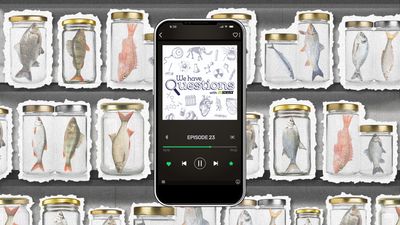
A picture of a mobile phone superimposed on a background of fish in jars.

You don't often find pickled fish stored in a bunker. But in Louisiana, you do. 

Image credit: New Africa/Andrei Kuzmik/dimidz/Jarama/Kornienko Alexandr/Regormark/schankz/solarus/spalnic/vitals/Jiri Hera/shutterstock.com; modified by IFLScience

If you’d visited a series of bunkers in Louisiana in the early 1940s, you would’ve found weapons. Lots of weapons. Visit it today, and you’ll find yourself wandering among row upon row of pickled fish.

It’s a curious makeover for a vast expanse of storage space, one that came to pass thanks to humans’ love of wacky fish and the alleged lack of integrity of Dinwiddie Hall’s floors. This is the origin story of Tulane’s Biodiversity Research Institute (TUBRI), a place where you can find fish that are extinct, fish that nobody’s ever seen alive, and a fish that's the only known specimen of a deep-sea shark. 

So, how did all ~8 million of these pickled fish get here, and why? We sat down with TUBRI director Brian Sidlauskas to find out.

You can listen to this episode and subscribe to the podcast on all your favorite podcast apps: Apple Podcasts, Spotify, Podbean, Amazon Music, and more.

This interview first appeared in Issue 43 of our digital magazine CURIOUS.


Written by 

Add us as a Google preferred source to see more of our
trusted coverage in Search