Nature
 PUBLISHED





On Boxing Day 2004, an earthquake off northern Sumatra unleashed one of the worst disasters in human history, killing an estimated 230,000 people and causing vast environmental harm. However, it wasn’t the quake itself that did most of the damage, the bigger problem was the tsunami, which caused devastation from Indonesia to Africa.
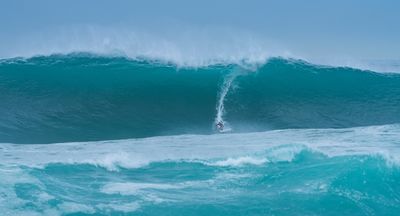
The tsunami was 60 centimeters (2 feet) high in deep water 2 hours after formation, and 24 meters (79 feet) when it reached the nearest coastline. That’s certainly an intimidating height, but the largest wave ever surfed was 26.2 meters (86 feet) high. Most of us would consider Sebastian Steudtner mad for taking on that challenge, but beachside buildings at Praia do Norte, Portugal, where he achieved the feat, didn’t get wet, and have seen bigger waves come and go safely out to shore.
So why is there a difference between an ordinary ocean wave and a tsunami? Despite their apparent similarity, the physics of the two couldn't be more distinct.
What Is A Tsunami?
Disaster planners have been very keen to see the Japanese word tsunami (literally harbor wave) replace “tidal wave” in English, since these disasters can happen at any point in the tidal cycle.
Tsunamis are usually caused by underwater earthquakes, landslides or glacier calvings, which trigger sudden movements of large amounts of water. The impulse usually occurs well beneath the water line – although there are exceptions – so far more water is affected than by ordinary ocean waves, which are largely the product of wind and therefore mostly affect water near the surface.
How Do Tsunamis Differ From Other Waves?
All waves are governed not only by their amplitude (equivalent to height for a water wave) but also their wavelength. Tsunamis and other waves may have similar amplitudes while out at sea, but their wavelengths are a different matter.
Standing on a cliff looking over the ocean, it’s easy to see that wavelengths for surface waves are usually a matter of tens of meters or low hundreds at most. Tsunamis, on the other hand, have wavelengths of up to 200 kilometers (120 miles).
The speed of travel represents another important difference. When a tsunami warning is issued, the time until the waves hit is usually a matter of minutes for nearby shorelines – making evacuation difficult. Even across an ocean it can be just a matter of hours. A tsunami off Japan, for example, will give Hawaiians a few hours to get safely inland. That’s similar to the flight time for a commercial aircraft over the same distance.
In contrast, surface waves are driven by the wind, and consequently move at tens of kilometers per hour.
What Makes Them More Dangerous?
In deep water, these differences actually make tsunamis far less of a threat to ships than ordinary waves. The long wavelength means when a tsunami passes, the rise and fall takes many minutes, even allowing for their great speed. Even the most sea-sick prone voyager won’t notice the equivalent of going up and down one floor of a building in the space of half an hour.
However, as a wave approaches the coast, the water its traveling through gets shallower. Friction between the seafloor and the water slows the wave down. Tsunamis’ speed is proportional to the square root of water depth, so there’s a big difference between the speed in the open ocean – around 5,000 meters (1,600 feet) deep – versus close to shore.
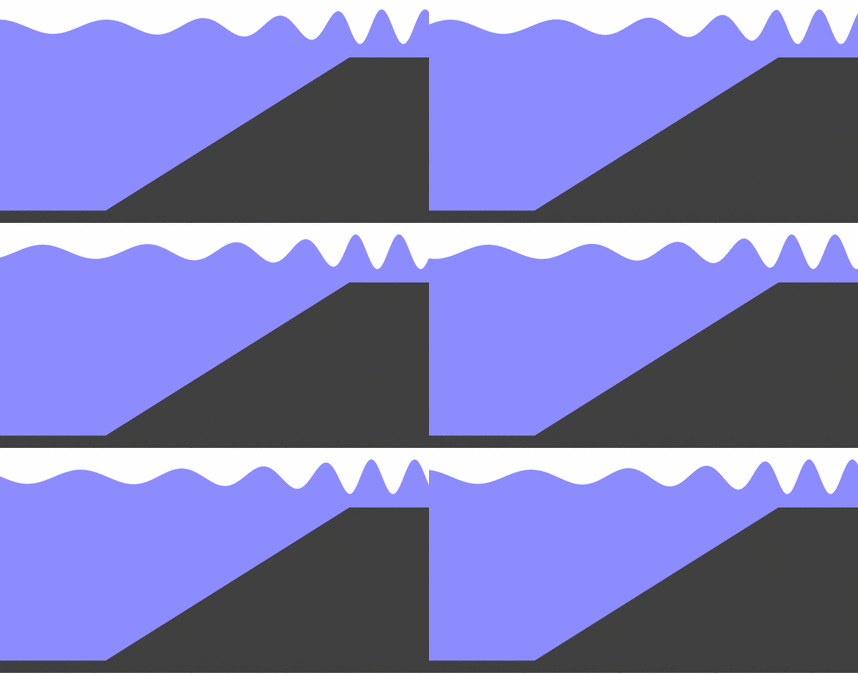
The front of the wave naturally feels this effect first, so water backs up behind it, like cars bunching up when suddenly encountering roadworks. For a water wave, there’s nowhere to go but up. As a result, a previously modest wave height rises rapidly, getting higher as the water gets shallower.
Both tsunamis and wind-driven waves do this, but when the wavelength is a thousand times longer, there is vastly more water to back up. The greater speed also means a tsunami is carrying a lot more energy than an ordinary wave of the same height in deep water.
Details of the shape of the seafloor off a coast will determine how high the tsunami gets, and therefore how much of a threat it poses, but in many places tsunamis will be tens or hundreds of times higher when they hit the shore than when they are out at sea. Consequently, when a warning is issued for a 60-70 centimeter (2 foot) tsunami, don’t be lulled into a false sense of security. That size is the wave height in deep water.
Depending on location, that could turn into something capable of sweeping far inland and wiping away buildings. We can identify historical tsunamis through enormous boulders the waves dumped on top of cliffs, and sometimes far inland.
For ordinary waves, the build-up is the reason surfing is best just before the waves break, rather than far out from shore. Big wave surfers understandably measure their conquests at their largest, not their height in deep water where the comparison with tsunamis would be more accurate. Aside from the point where the waves are measured, which exaggerates normal waves in comparison with tsunamis, the much shorter wavelength and lower speeds of ordinary waves mean there simply isn’t enough water or energy for them to do much damage.
Tsunami trains
Tsunamis usually travel in “trains” of several waves, and the first isn't always the highest. Each wave involves both a crest and a trough. Depending on the tsunami’s cause, the trough may reach shorelines first. In that case, instead of a towering wave, the first sign of danger will be the ocean drawing far out to sea, before rushing back. Recognizing what is happening, including other signs like extra foam and knowing not to assume the danger has passed after the first crest, often makes the difference between life and death.
Mega and Meteo-tsunamis
In the interests of maximum safety, it’s also worth adding some words about unusual types of tsunamis.
Megatsunamis (more than 100 meters or 330 feet high) occur in lakes or isolated bays, mostly when landslides dump large blocks of rock or ice into the water, causing scaled up versions of ripples on a pond after a stone is thrown in. If a megatsunami reaches open water it spreads out, and the wave height can drop to safe levels. But within a constricted space, heights of 524 meters (1,700 feet) have been recorded. It isn't hard to see why these sorts of waves can be devastating, although thankfully they are most common at very high latitudes where few people live.
Under rare circumstances, a megatsunami becomes a seiche, washing back and forwards for hours or days.
Last week, an Argentinian beach was struck by a meteotsunami, killing one person and injuring many more. Unlike most tsunamis, meteotsunamis (short for meteorological tsunami) are caused by atmospheric conditions.
Meteotsunamis occur when very sudden weather events, such as thunderstorms, cause a rapid rise or fall in barometric pressure. When the change sweeps in perpendicular to a shoreline at the same speed as local waves, it can cause a long-period wave in deep water that builds up as it hits the shallows, becoming indistinguishable from a small conventional tsunami.
The energy of even the largest storm is much smaller than that released in a major earthquake, so meteotsunamis aren't powerful enough to wreak havoc on the other side of a major ocean. Nevertheless, they can be lethal locally, particularly when beachgoers don’t realize the danger.