Nature
 PUBLISHED



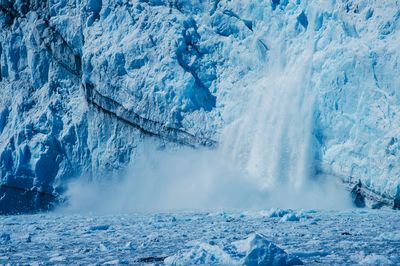


The front end of glaciers in Antarctica that flow to the coast break apart due to melting, creating icebergs. These are known as calving events, and they can have dramatic consequences. Not only are large chunks of ice then free to move and reach lower latitudes, the process can also create powerful “internal tsunamis” that profoundly alter the ocean.
Internal tsunamis are a recent discovery. They are invisible in the sense they don’t create massive wavefronts, but can still shift a significant amount of water. They can happen in oceans and lakes without being noticeable on the surface.
The latest study was conducted by a team on board the research ship RRS James Clark Ross, part of the British Antarctic Survey (BAS) fleet. The scientists were taking ocean measurements close to the William Glacier, and they witnessed the entire front shatter into a thousand pieces.
The front of the glacier was as high as 40 meters (131 feet) above sea level and the amount of ice that broke off had a surface area of 78,000 square meters (840,000 square feet), or about 10 soccer pitches. This might not seem much, but it generated an internal tsunami with underwater waves as tall as a house.
"This was remarkable to see, and we were lucky to be in the right place at the right time. Lots of glaciers end in the sea, and their ends regularly split off into icebergs. This can cause big waves at the surface but we know now it also creates waves inside the ocean. When they break, these internal waves cause the sea to mix and this affects life in the sea, how warm it is at different depths and how much ice it can melt. This is important for us to understand better,” lead author of the study Professor Michael Meredith, head of the Polar Oceans team at BAS, said in a statement.
Ocean mixing is a key process for the distribution of nutrients across the vast bodies of water. It was believed that it was mostly caused by wind and tides, but this work suggests that iceberg calving causing internal tsunamis also plays a role in the mixing. The team measured temperatures in the ocean and discovered that the tsunami had evened out the temperatures across different depths.
"Our fortuitous timing shows how much more we need to learn about these remote environments and how they matter for our planet," Professor Meredith stated.
The study is published in the journal Science Advances.