Nature
 PUBLISHED


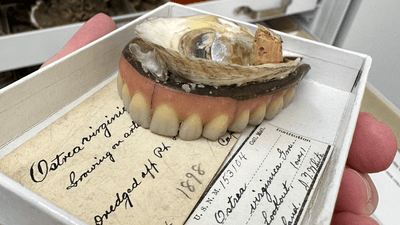


Were you to drop your false teeth into Chesapeake Bay, chances are you wouldn’t expect to see them again. Weirder still would be to see them in the paper and learn that an oyster had claimed them as their own.
And yet, this is precisely what spray painter George Chesky thought had happened to him in 1954.
It’s a curious tale that begins with a set of false teeth you can still see today if you visit the Smithsonian National Museum of Natural History. The specimen has been with them since 1898 after it was discovered by a dredging boat in Chesapeake Bay, Virginia.
These aren’t just any dentures, however. Glued to the false teeth is an oyster, Crassostrea virginica.
Also known as Eastern oysters, they’re considered a keystone species of the Chesapeake Bay ecosystem. They provide food and shelter to other organisms. As filter feeders, they get rid of harmful algae and remove excess nutrients.
They also have a curious life cycle that can explain why anything dropped in the bay is fair game as far as oysters are concerned.
The life of an oyster
In spring, warm waters trigger adult oysters to spawn. They’ll release millions of eggs and sperm into the environment, and these fuse to form an early embryo.
That embryo then develops into a larva that, unlike adult oysters, is free swimming. They’ll drift around for two to three weeks, and then it’s time to settle on a new home.
Larvae can crawl along the riverbed using a muscular foot. As soon as they’ve found the perfect spot, they use a unique adhesive material to glue themselves on.
Thing is, oysters aren’t too fussy about what that surface is.
We’ve found oysters glued on everything from shipwrecks to teapots and – yes – the occasional pair of dentures. It’s a home they must make peace with as they’ll be stuck to it for the rest of their lives.
So, had this Eastern oyster claimed Chesky’s beloved teeth?
A most scandalous theft
Chesky, convinced by images shared in the Washington Star that the oyster’s teeth were his own, made a request to Smithsonian that their rightful owner be acknowledged. It was, however, a request they denied.
You see, in his excitement Chesky had missed one crucial clue as to the rightful owner of the teeth.
His own teeth were said to have been lost during a failed fishing trip with friends. Without a bite, the pals went swimming, and it was then that the teeth slipped out of his mouth and drifted down to the oyster bed below.
Thing is, this was a story he recounted at age 43 in 1954. That means when the oyster with teeth was discovered in 1898, Chesky was still 13 years off being born.
Better luck next time, bud.
Important stories, unlikely specimens
No doubt a disappointing end to Chesky’s search for justice, but these teeth still tell an important story. When this young spat settled on their surface, it was a time when Chesapeake’s oyster numbers were taking an unfortunate turn.
Overharvesting and dredging decimated their numbers, and combined with the pollution and habitat loss that’s developed over the last century, it’s still a tough time for Eastern oysters. Still, the Chesapeake Foundation reports that their population has tripled in the last 20 years.
Happy news for one of the Smithsonian’s most quirky specimens.
“Oysters are an important part of our region's natural and cultural history,” said John Pfeiffer, research zoologist and curator of bivalves at the National Museum of Natural History. “These specimens are bizarre, but they tell an ordinary story from the past – a time when oysters covered the Chesapeake Bay.”


 3
3