Nature
 PUBLISHED



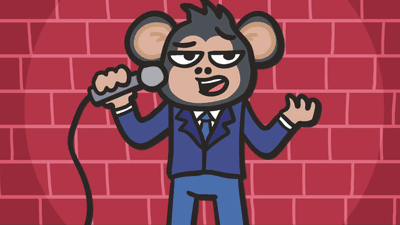


“What can you think of that is hard?” an unlikely comic asks. “Rock” and “work” come the reply. It might not be the most side-splitting of jokes, but it is the work of an ape, so we’ll let it slide.
The creator of this witty wisecrack is, of course, Koko, the inimitable western lowland gorilla who mastered sign language before her death in 2018 at the age of 46.
Other anecdotal evidence seems to confirm that animals not only know how to have fun but they know how to make fun, tell jokes, and engage in slapstick comedy.
Marc Bekoff
Other gags from the amusing ape include tying her trainer’s shoelaces together before signing “chase”, and a quip that her middle name was “Devil”. What a joker!
After decades of imitating humans, it may well have looked like Koko had mastered the art of telling a joke, but it raises the question: Do non-human animals have a sense of humor?
Darwin thought so. In The Descent of Man, the father of evolutionary theory argued that “the difference in mind between man and the higher animals, great as it is, is certainly one of degree and not of kind” – in other words, if we have a sense of humor, then it’s likely that, on some level, other species do too.
But what does modern science have to say on the matter?
Comedic creatures
As many pet owners will be able to attest, some animals seem to possess a sense of humor of sorts. My own dog, Betty, takes great pleasure in hiding under the table at the most inopportune of moments, evading capture as I attempt to usher her to bed or dare to suggest we brush her fur, barking gleefully as she does so and as I become increasingly irate.
Writing about it now, it’s admittedly a pretty funny bit, though it’s decidedly less entertaining at 11 pm or when the train I need to catch looms ever closer.
Evidence of this ilk is abundant, just ask anyone who spends a lot of time with animals. As Marc Bekoff, professor emeritus of ecology and evolutionary biology at the University of Colorado, writes in his book The Emotional Lives of Animals: A Leading Scientist Explores Animal Joy, Sorrow, and Empathy – and Why They Matter.
“Other anecdotal evidence seems to confirm that animals not only know how to have fun but they know how to make fun, tell jokes, and engage in slapstick comedy.”
Bekoff regales with a tale of his own late canine companion Jethro, who “used to run all over with his favorite toy, a stuffed rabbit, in his mouth.
He’d scoop it up on the run, bound here and there, and then turn to see if anyone was watching. If they were, he’d continue his frantic game. My friends and I would always laugh, which apparently was the reward Jethro was looking for.”
He also details the accounts of friends who have spotted Asian black bears mischievously stealing food and toys from other bears “like a greedy sibling”, and a scarlet macaw, named Mac, who “giggled, chuckled, and roared with laughter; he teased all who came near, squealed with delight when running around the house, bounded up and down on trees outside, and even played ‘magic carpet’ – wherein his human slaves raced down hallways dragging large towels with the macaw riding aboard.”
Scientific literature on the subject is less bountiful – though that’s not to say that research on animal behavior that could be interpreted as humorous is nonexistent.
Comedy great (apes)
Just last year, researchers led by Isabelle Laumer at the University of California, Los Angeles, published a study detailing spontaneous playful teasing in four great ape species: orangutans, chimpanzees, bonobos, and gorillas.
In humans, teasing is seen in babies as young as 8 months old, and, because it doesn’t require language, is a good place to start when looking for signs of humor in other species.
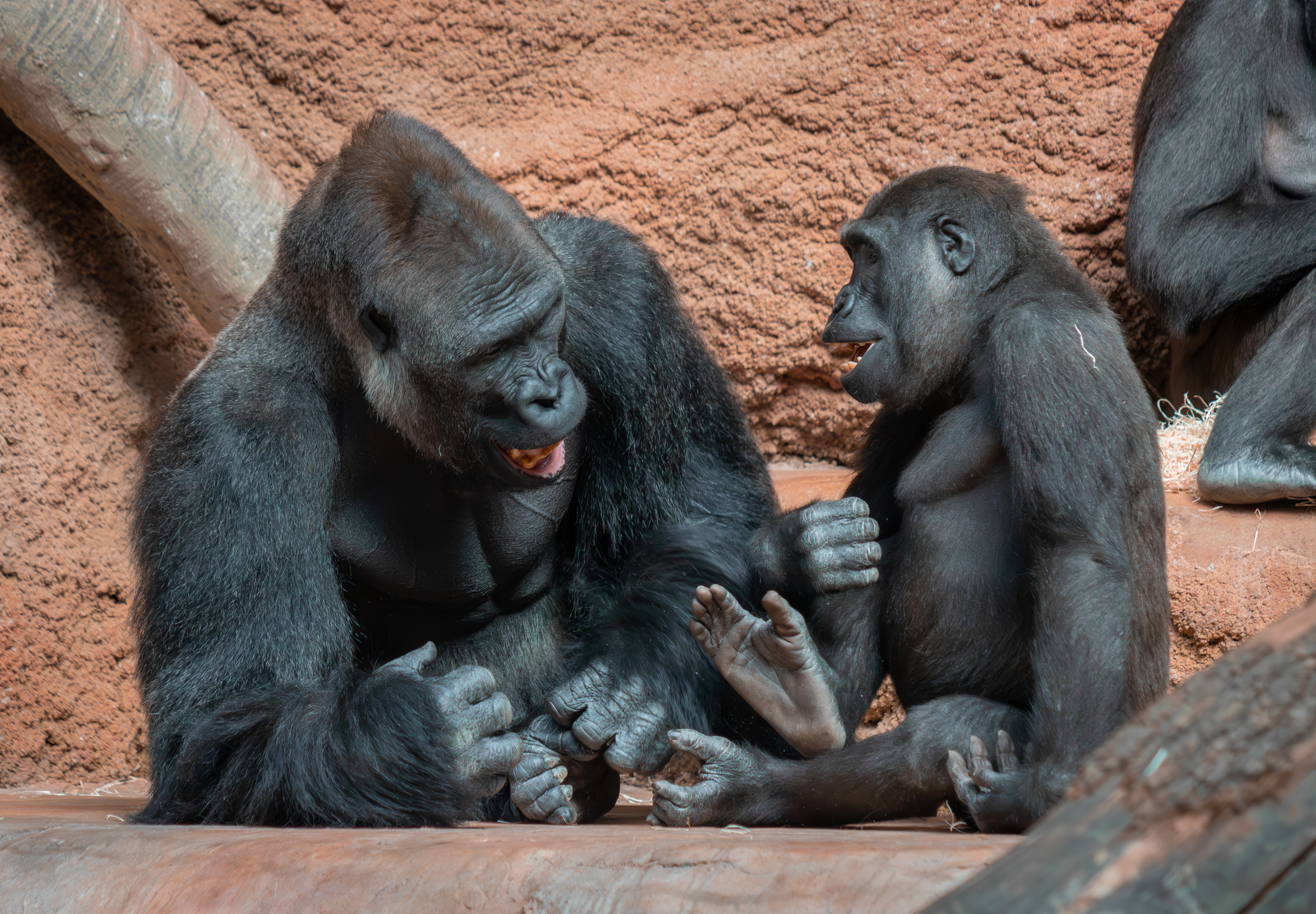
While analyzing the apes’ body movements, facial expressions, and actions, the team identified teasing behaviors coinciding with what looked like play, including poking, hitting, hiding, and pulling on a body part.
Some apes waved objects in front of their fellow apes' faces, and orangutans even pulled each other's hair. The playful teasing was intentional, provocative, and persistent, often appearing to center around triggering a response or trying to get another individual’s attention – sound familiar?
“From an evolutionary perspective, the presence of playful teasing in all four great apes and its similarities to playful teasing and joking in human infants suggests that playful teasing and its cognitive prerequisites may have been present in our last common ancestor, at least 13 million years ago,” said Laumer in a statement.
Essentially, teasing could represent a primitive form of humor in the great apes, which has evolved into comedy as we know it in our species.
Previous work has established vocalizations akin to laughter in great ape species.
In a 2009 study, Marina Davila-Ross, Associate Professor in Comparative Psychology at the University of Portsmouth, and co-authors compared tickle-induced vocalizations in orangutans, gorillas, chimps, bonobos, and human infants.
Some people (skeptics) might say the animals don't really enjoy what they're doing and that it's instinctual, but that explanation ignores decades of research on animal emotions.
Marc Bekoff
The researchers noticed similarities between them, in line with the evolutionary tree – chimpanzees and bonobos, our closest relatives, sounded most similar to humans, while orangutans, to whom we’re much more distantly related, panted in the least human-like way.
This suggests great apes may also possess the ability to laugh, offering a glimpse as to how human laughter might have originated pre-language.
It makes sense that the great apes exhibit these sorts of behaviors – we are, after all, great apes ourselves – but what about other species, more far-removed from our own?
Animal stand-up
Research in a number of other species has hinted that humor may be more widespread in the greater animal kingdom.
"I believe that nonhuman animals have a sense of humor. It may be expressed differently even among members of the same species – think of dogs, for example – as it is in humans,” Bekoff told IFLScience.
“When you think of the evolution of social living among different animals, there’s no reason why we shouldn't consider the likelihood that they have the cognitive and emotional capacities to play games, joke around, or have a sense of humor to ‘lighten the load.’”
Bekoff’s own research in dogs has revealed teasing behavior similar to Laumer’s observations in the great apes, something he argues can be interpreted as a sense of humor.
For example, he has witnessed dogs slowly approaching others with a loose, gamboling gait before running away in an apparent attempt to instigate a chase. He also describes dogs feinting right and going left – something I’m painfully familiar with thanks to Betty’s under-the-table shenanigans.

Other examples of a potential sense of humor in animals include “giggling” rats – adorably, the rodents emit chirps of pleasure when playing or being tickled and have even been taught to play hide and seek in return for a "tickling reward".
Meanwhile, bottlenose dolphins appear to smile when playing with their friends and are notorious for their joyful vocalizations when playfighting.
Is this really humor?
As endearing as it might be to imagine apes cracking jokes and rats cracking up, are these behaviors really indicative of a sense of humor, or is there another explanation?
It helps people realize that many other animals have rich and deep cognitive and emotional lives and they're not simply behaving mechanically – they're thinking about and feeling what's happening to them or around them and adjusting their behavior accordingly.
Marc Bekoff
It could be argued that their doing so is innate, or that they act like this for reasons beyond their own enjoyment, perhaps to avoid a fight or get attention, for example.
“Some people (skeptics) might say the animals don't really enjoy what they're doing and that it's instinctual,” Bekoff told IFLScience, “but that explanation ignores decades of research on animal emotions.”
Ultimately, we need more formal study of these types of behaviors in animals to truly understand them, but the evidence we have so far, albeit largely anecdotal, certainly seems to hint at humor.
If this turns out to be the case, then you may well be wondering why that is. We don’t know for sure, but it’s possible that teasing, laughter, and humor itself serve similar roles in animals as they do in humans – this could mean to aid social bonding, strengthen relationships, and avoid conflict.
Why did the chimp cross the road?
While we must tread carefully so as not to anthropomorphize non-human animals, there is much we can learn about the species we share our planet with from studying potential manifestations of humor.
For instance, it highlights the similarities we share, particularly with our closest relatives, and raises awareness about the importance of protecting these animals, many of which are endangered.
“It helps people realize that many other animals have rich and deep cognitive and emotional lives and they're not simply behaving mechanically – they're thinking about and feeling what's happening to them or around them and adjusting their behavior accordingly,” Bekoff explained.
The benefits of this area of research even extend to our own species.
“Studying the complexity of positive behaviours is vital in understanding better why we behave the way we do,” Davila-Ross told IFLScience. “With increasing research on this topic, we discover important similarities between humans and nonhuman primates, not just differences. It is especially interesting currently, where a key distinction of humans is discussed in terms of our social cognition in relation to cooperation.”
From teasing apes and giggling cetaceans to spilling secrets of our own evolution and behavior, humor in the animal kingdom is no joke.
This Deep Dive first appeared in Issue 38 of our digital magazine CURIOUS. To access exclusive CURIOUS content first and receive the quarterly digital magazine, become an All Access Member.