Nature
 PUBLISHED





What you'll discover in this article
- West African crowned cranes are endangered in their native range across Africa.
- As part of a conservation program to safeguard the species, Brevard Zoo in Florida were given the go ahead to breed a pair known as Royal and Goose, who produced little chick Pip.
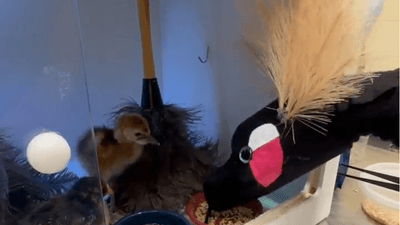
- Whilst getting a check up from keepers, they used a crane puppet so that Pip imprinted "on something other than a human to help set him up for success later in life," Brevard Zoo told IFLScience.
An endangered chick that hatched at a zoo in Florida had inspired keepers to get creative and make a West African crowned crane hand puppet to help it feed.
The chick, named Pip, needed a little TLC before rejoining his family, so the puppets were sent in to prevent him from imprinting on humans.
Our team fed the chick using a look-alike hand puppet, so Pip continued to associate food and crane behaviors with birds and not humans.
Brevard Zoo
It was the psychologist Konrad Lorenz who was the first to conduct experiments into imprinting in birds. The process describes how certain chicks will bond with the first large moving thing they see upon hatching.
Typically, this will be its mother, which is why you see ducks swimming around with a charming tail of ducklings.
But baby birds aren’t so choosy, as demonstrated by Lorenz who used to go swimming with a queue of geese in tow. While not all birds imprint, West African crowned cranes do.
This was something Brevard Zoo had to keep in mind when their crowned crane breeding duo Royal and Goose got the go ahead from the Association of Zoos and Aquariums Species Survival Plan to try and have a baby.
The first green-blue eggs laid showed no signs of life, but then came Pip’s beak zipping its way through his egg.
Our goal was for Pip to imprint on something other than a human to help set him up for success later in life.
Brevard Zoo
The precious chick was kept behind the scenes to check he was healthly, before being reintroduced to mom and dad. During his time away from his parents, the keepers kept him fed with a few neat tricks.
Yes, it was time to send in the puppets.
“For the first few weeks, our team fed the chick using a look-alike hand puppet, so Pip continued to associate food and crane behaviors with birds and not humans,” said a Brevard Zoo representative to IFLScience.
“Our goal was for Pip to imprint on something other than a human to help set him up for success later in life by seeking out fellow birds, not humans.”
This is an established practice known as puppet rearing, and it seems to be an effective strategy across numerous species. After all, if Spy In The Ocean taught us anything it’s that animals can be reasonably easily fooled and will even try to protect their artificial counterparts.
To keep the family connected, the team also played recordings to Pip of vocalizations from Royal and Goose , and in return they got to listen to recordings of their chick. The goal of the temporary separation was to ensure he was growing as expected, as a tiny chick like Pip can mean great things for an endangered species.
West African crowned cranes are endangered in their native home due to habitat loss and other threats. Pip’s planned hatching forms part of the Association of Zoos and Aquariums’ Species Survival Plan, with a goal to safeguarding the population within accredited zoos should they go extinct in the wild.
Big hopes for a baby bird, but nobody said you couldn’t have a little fun with puppets along the way.


 1
1