Nature
 PUBLISHED
 1
1


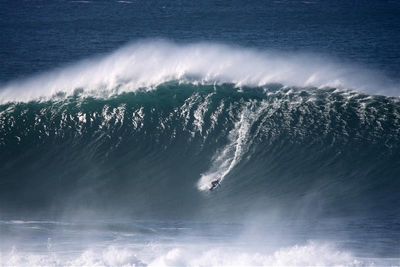


Nazaré on the coast of Portugal is famous for summoning some of the biggest surfable waves on the planet thanks to the unique deepsea geology that sits on the seafloor. Elsewhere, however, bigger waves have been reported (although good luck surfing them).
Sebastian Steudtner earned the world record for the largest wave ever surfed on October 29, 2020, when he successfully cruised down a 26.21-meter (86-foot) tall wave off the coast of Praia do Norte, Nazaré.
Over the past 14 years or so, this small part of the Atlantic has been the site of numerous world records for big-wave surfing – and for good reason. The monster waves are cooked up by Nazaré Canyon, a submarine trench just off the coast of Nazaré in the eastern North Atlantic Ocean.
Around 227 kilometers (141 miles) long and 5 kilometers (3 miles) deep, the canyon runs perpendicular to the Portuguese coast and effectively funnels the powerful waves generated in the Atlantic towards the shore.
“Usually, when the large open-ocean swells approach the coast they start to slow down by interaction with the ocean bottom. However, at Nazaré offshore the ocean swells get focused in the submarine canyon that points to the coast and do not lose energy until they reach the near shore. As the waves emerge at the canyon head, they reach very shallow bottom and became suddenly very high,” explains a 2015 book from the University of Coimbra in Portugal.
The effect is so concentrated that waves are significantly milder just a few hundred meters away from the focal point near Praia do Norte.
Bigger waves are possible, although they’re typically found in very unique situations.
One of the tallest waves on record was drummed up on July 10, 1958, when a magnitude 7.8 earthquake rocked the Fairweather Fault in southeast Alaska, causing 90 million tons of rock to plunge into Lituya Bay. The resulting wave was absolutely enormous. Wave damage was documented in the forest up to 200 meters (700 feet) around the surrounding hills of the bay. In part of the bay, waves appear to have splashed up to an elevation of 524 meters (1,720 feet) — that’s almost as high as One World Trade Center, the tallest skyscraper in North America and the Western Hemisphere.
It’s estimated that the Chicxulub impact, aka the asteroid that killed the dinosaurs 66 million years ago, likely caused a ring-shaped tsunami wave as high as 1.5 kilometers (0.93 miles) to emanate from the Peninsula in modern-day Mexico.