Nature
 PUBLISHED




Researchers have visited a small island in Kenya where for the last five years animals had been living with no natural predators, after the island became cut off from the mainland. Rather than a paradise where prey animals can live stress-free, away from the threat of surprise lion attacks, it appears that being largely predator-free brings its own problems.
Around 80 kilometers (50 miles) northwest of Nairobi, Kenya, is Lake Naivasha, host to a small island named for its shape. Crescent Island, really the rim of an ancient volcano, has historically only been named correctly for part of the time. Whilst often an island, as the water levels rise and fall it switches between being an island and a peninsula, allowing animals from the mainland to come and go via a small causeway.
In 2020, however, the water levels rose above the causeway, putting a stop to the wildlife traffic, and has not emerged from the water since.
Five years on, researchers from the School of Veterinary Medicine, St. George's University, Canada, visited the island to asses what impact this has had on the animals, many of which are unable to attempt to cross the water back to the mainland.
As you might expect, it isn't all bad. The team found that there were few carnivores on the island, and those were mainly bat-eared foxes and silver backed jackals, neither of which pose a danger to larger prey animals. In this environment, these larger prey animals have sustained a fairly large population.
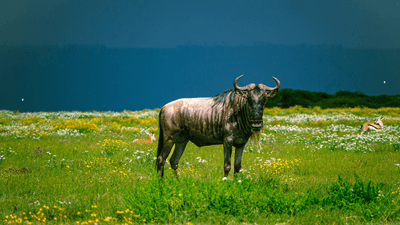
"During the study period, an abundance of herbivorous grazers such as impala, waterbuck, zebra, dik dik, wildebeest and spring hares, as well as some giraffes and many hippopotami were observed," the team explains in their study.
Some of these animals, like zebras and waterbuck, may be able to leave the island by swimming, but others are not so lucky. Giraffes, despite basically having evolved into snorkels, have only been seen attempting the crossing whilst the water levels were at their lowest.
So, it's some sort of paradise for large prey animals? Not quite.
"The prolonged absence of large predators has likely contributed to sustained grazing pressure by the island's herbivore community," the team explains. "Combined with the inability of most species to disperse from the island, this has resulted in extensive vegetation degradation and increased reliance on supplemental feeding."
In the long term, the team writes that overgrazing and a lack of time for the vegetation to recover, coupled with a decline in plant diversity, may make the situation unsustainable for the island's inhabitants.
"Field observations suggest the island may be approaching or exceeding its ecological carrying capacity and is at risk of a decline in flora and fauna alike," the team explained, whilst stressing that these are observations of the island, rather than a census.
"The apparent decline may reflect disease, nutritional stress, interspecific competition, or a combination of factors. Unfortunately, since population numbers are not being consistently monitored, the true carrying capacity of the island cannot be calculated."
Gazelles on the island, meanwhile, have been suffering from an undiagnosed disease. An autopsy on one animal revealed damage to lung and liver tissue consistent with infection from Mycoplasma mycoides subsp. capri, a bacterial pathogen that largely infects sheep and goats, but tests were not conducted to see for certain.
While certainly concerning, the team suggests that the situation can be managed in a number of ways.
The first is to do proper and continuous surveillance of the island, taking a census of the wildlife and plant life that lives there, a task that they said could be conducted by guides already on the island.
Another is to restore the habitat on the island, giving the vegetation a chance to recover. This could be achieved through irrigation, as well as strategically fencing off areas for a time, and guiding animals towards other areas of vegetation.
Re-establishing a permanent artificial causeway could also be an option, though the team do not favor this due to uncertainty in future water levels, and the risks posed to the mainland through disease transmission.
Reintroducing predators into the situation – according to local guides, hyenas have been translocated to the island in the past – may also be an option. But generally, reintroductions of predators (see: parachuting wolves) are done in much larger areas, and the team does not favor the idea due to safety and genetic isolation concerns.
Nevertheless, Crescent Island appears to be a problem that may require a little intervention, rather than the predator-free paradise the gazelles were hoping for.
The study is published in Frontiers in Sustainable Tourism.