Nature
 PUBLISHED





Everyone's beliefs are getting a little too weird for my tastes, so to fit in, I've decided to adopt an unusual pet theory of my own: there are panthers running around the valleys and mountains of north Wales like rabbits, and nothing you can tell me about sustainable big cat populations will persuade me otherwise.
The key to choosing an unorthodox belief is to make it as weird as possible while also being somewhat plausible and difficult to rule out. Flat-Earthers, though choosing an intuitively plausible idea (it sure does look flat from down here, don't it), fail by choosing one you can disprove with a lunar eclipse or a stick.
My new belief has the advantage of being undoubtedly weird, being difficult to rule out (good luck searching the whole of North Wales, buddy, the only standard of proof I will accept), and, of course, being 100 percent true; there are loads of pumas swanning around north Wales.
Why are you saying this? Is it brain worms?
Claims about having seen big cats, like lions, tigers, and pumas, are very culturally specific. If you yell "leopard" in sub-Saharan Africa, for example, you might receive the reply "aghhhhhh!" indicating a level of trust that there may actually be a leopard there.
If you are in suburban Caernarfon, however, you're more likely to get follow-up questions about whether you need a lie-down or, perhaps, slightly fewer bong hits in the future. Despite these cultural barriers, which, if you are the skeptical sort, you may say have more to do with the confirmed locations of big cat populations, there have been plenty of sightings of big cats in both these regions.
Admittedly, these date back a little longer in sub-Saharan Africa than the 1970s, but let's not dismiss stories of pumas in north Wales just because they began in the Blondie era. Scientists are always arguing that we should pay more attention to local knowledge, all I'm saying is that should also be applied to the Welsh.
"Personally, I've never seen any. But the area I grew up in had a few 'big cat' legends, often known as 'The Beast of insert village name.' They were usually backed up by hearsay of farmers mysteriously losing some sheep here and there, or 'My dad's mate said he saw a massive cat in the field next to his place' type of second-hand accounts," explained Chris Carpineti, IFLScience's resident media manager and representative Welsh person.
"Do I think it's plausible? Yes! I love the idea of the cryptid-adjacent myth of the whole thing, but also it always sounded feasible that at some point they could've escaped from a zoo or from someone's house after a dodgy black market animal trading where someone bought a big cat, and it was either released or escaped once it reached a size too large or dangerous," he added.
"Finding out that the latter has indeed been known to happen made me lean even more towards the chance that there are a few big cats roaming the hills, and that's not even taking into account how many apparent witness testimonies have been recorded. People are seeing something."
So how would big cats get into north Wales in the first place?
Since I'm the one yelling "puma" here, I think it's only fair I go into a little background. Big cats aren't native to the UK. But since at least the 1970s there have been cases of people claiming to have seen them in the wild, and they've supposedly even been spotted attacking members of the public.
Now, as someone who works for a science website, I understand the need to be skeptical, and big cats are unlikely to commute to Llangollen or face the nightmare of the UK visa system.
But as stupid as it sounds, prior to the Dangerous Wild Animals Act of 1976, people were allowed to keep these large cats as pets. If you had enough money for it, you were theoretically allowed to take your pet lion openly around the park like a pug.
When the act put a stop to owning these wild and dangerous animals as pets, many donated them to zoos. But there are rumors that some people simply released their massive moggies to fend for themselves in the wilds of the UK. And some cases went beyond rumor.
One farmer, who I will begrudgingly confess was in Scotland (where I have inexplicably chosen to believe there are zero pumas), noticed his livestock going missing over the course of a year before seeing a “lioness or similar member of the big cat family” stalking horses at a nearby farm.
The attacks continued, and farmer Ted Noble ended up catching what turned out to be a female puma, using a sheep's head as a lure. The director of the Highland Wildlife Park at Kincraig determined the cat was too well-fed and too tame to have been living in the wild for long and had likely been released by someone who used to own it as a pet.
A big win for the "see, there are pumas running around the UK," crowd, to be sure, but sadly, again, I must dismiss it for not being in Wales.
During the 1980s, there were plenty of reported sightings to choose from in the UK, with media interest adding fuel to the fire. Dramatic names were given to sightings, like the Black Beast of Exmoor and the Beast of Bodmin Moor.
"The Beast is the result of some sixty sightings of a black panther-like big cat, supposedly three to five feet long and sporting white-yellow eyes, combined with numerous reports of mutilated livestock," the Cornwall Guide recounts. "The evidence was robust enough that in 1995 the government ordered an official investigation into the existence of such a beast."
That official investigation, however, found no credible evidence of a beast [leans in close], which, of course, is just what the beast would have wanted.
So are there still sightings or what?
Freedom of information (FOI) requests to the Welsh Government have revealed that reports keep coming in, with 15 reports of sightings between 2020 and 2025, though admittedly they vary in quality.
"Reporter and spouse at home watching a film, they heard a strange noise outside of the property. They stopped the film and could hear what they described as a deep/low growling similar to a big cat," an FOI document explains of one intriguing incident. "They have checked their CCTV, nothing has been seen on the footage, however there is audio of the noise described."
"Reporter was walking through the woods with the family when they saw the big cat asleep on the branch," another report announces. "Reporter took a photo and video. Looking at the photo it doesn't look real, ears are too round, more like a teddy bear, very light in colour possibly a carving or stuffed toy."
While the causes of these sightings were undetermined in most of the cases that weren't concluded to be teddy bears, other investigations have been more full-throated. When a suspected big cat was filmed in 2004 by tourists and thought to be the size of a panther, members of the Welsh government headed down to the spot to Miss Marple the situation and recreate the footage.
"The same camera was used and it was taken at the same zoom and from the same position as the original video," a spokesperson explained to the BBC. "A comparison of a single frame from the original video and a single frame of the video of a colleague clearly shows that the animal is the same size as a domestic cat."
Now the eggheads out there might be thinking, "Well, if the investigations into this largely conclude these are animals around the size of a domestic cat, is there a chance we're talking about domestic cats here?" But to you I say this: oh, have you not heard of puma kittens?
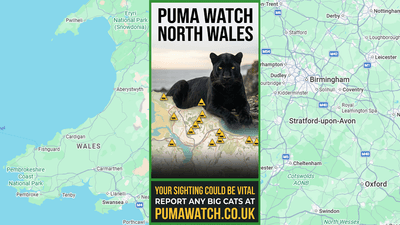
In recent years, the organization Puma Watch North Wales has been keeping tabs on sightings of potential large cats roaming in the area. Reports regularly come in, with the most recent one taking place in July 2026.
There is, I grudgingly admit, a little bit of a problem with the idea that there are still big cats living free and wild in north Wales. If there really are large cats running around the place, that requires a breeding population of them, and quite a large number at that. Given that it isn't exclusively pumas that have been spotted, we may also require a breeding population of lynxes, for example, in order to explain the sightings.
Big cats require a lot of space, in ideal circumstances.
"Although we observed pumas in patches as small as 1 km2, logistic regression models indicated a threshold occupancy probability between 300 and 400 km2, which is remarkably close to the mean male puma home range size in coastal California (~381 km2)," one study explains.
"Puma populations dependent on habitats below this value may be susceptible to inbreeding depression and human-wildlife conflict, and therefore vulnerable to extirpation."
I.e. If they were in Wales, which isn't the ideal puma habitat to begin with, we should maybe expect to see them coming into contact with more people than we have seen so far.
Now you may say that if there are quite a lot of them, they ought to leave quite a lot of evidence, beyond the occasional mauling and a sighting that turns out to be a cat, but to that I say this: yeah, ok, fair point, but my mate reckons he saw one.
"I was between Betsy Coed and Capel Curig. Close to Moel Siabod cafe," Matt Lang, a geologist whose word I 100 percent trust, told IFLScience. "As I was driving it leapt across the road in front of me. Looked about as long as half the width of the road as it leaped across," he added, estimating that it was 1.5-2 meters in length, "black," and "looking bigger than a cat, but moved like a cat."
In the end, that's good enough for me to go all in on this unscientific belief, and I won't back down until you have searched the entirety of north Wales to prove me wrong. Maybe drain Loch Ness whilst you're at it.
IFLScience Hot Takes is a semi-satirical Opinion column where we take a silly or outrageous idea and argue for it as if it's our earnestly held belief… as long as we can find good scientific reasons to back it up.
Do you agree with James? Could there be big cats hiding out in the hills of north Wales? Let us know!