Nature
 PUBLISHED






A tiny single-celled amoeba has been found surviving and thriving in a volcanic stream at temperatures that would kill any other known complex organism.
While simple bacteria and their cousins, archaea, have been shown to shrug off heat up to and beyond an extraordinary 100°C (121°F), no complex organism – any living thing whose cells have a nucleus – has previously been seen replicating above 60° (140°F).
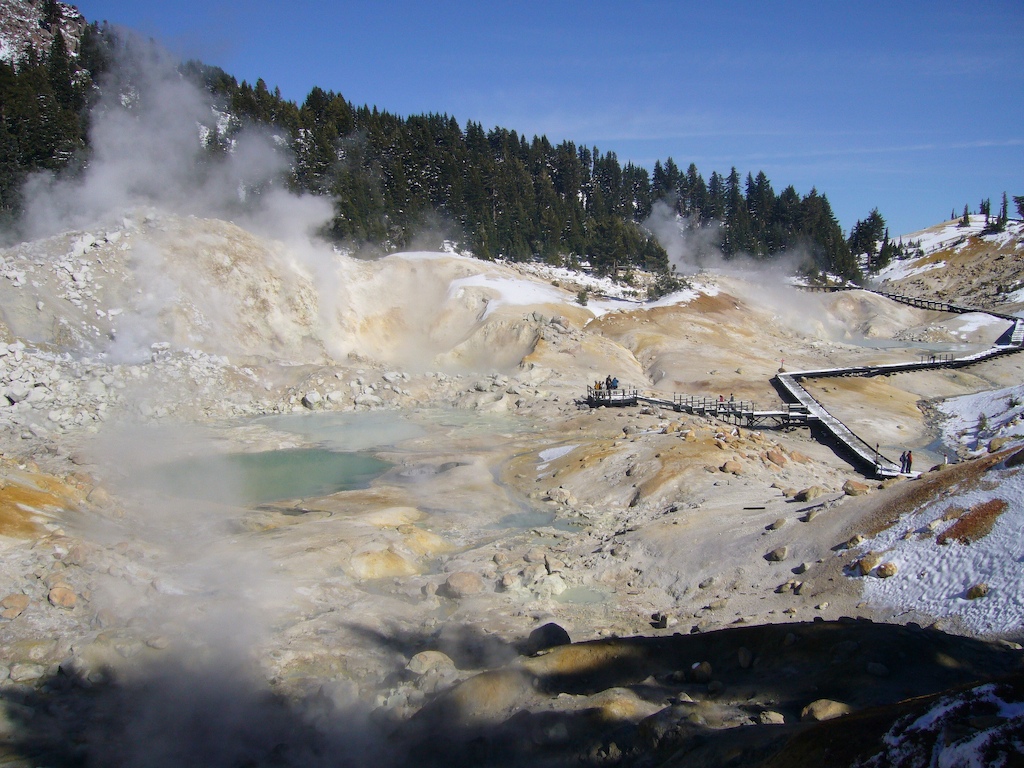
That's why it was surprising when a newly discovered microbe was observed eating and reproducing in hot spring water up to 63°C (145°F). Living in Lassen Volcanic National Park in California's Cascade Range, the amoeba has been named Incendiamoeba cascadensis, which appropriately translates to "fire amoeba from the Cascades."
"This finding pushes the bounds of what we thought was possible, which is incredibly exciting," said Angela Oliverio at Syracuse University in New York, in a statement.
"There could be more eukaryotes that can survive at even higher temperatures than we know of."
The researchers said temperatures of around 60°C (140°F) have long been considered the upper limit for complex organisms. Previously, we've only ever found other complex microbes like fungi and red algae living and replicating a few degrees below that threshold.
But exactly why eukaryotes struggle to make it past this limit isn't entirely understood. Archaea, including the species Methanopyrus kandleri, have been documented living around hydrothermal vents in the deep oceans at temperatures up to a sweltering 122°C (252°F).
Looking for clues as to the differences, the researchers profiled I. cascadensis's genome and compared it with those of three more mild-temperature amoebae. They found that more than 50 percent of I. cascadensis's genes were unique to its lineage, indicating it is highly adapted to its geothermal lifestyle.
Literally so hot right now
By predicting the properties of the amoeba's proteins, the researchers found that they "melt" on average about 4°C higher than for most other amoebae.
Above this melting point, the proteins start to lose their defined shape. Similar to how melting the gearbox of your car would cause you some problems when driving, this generally has an adverse effect on the essential processes of life.
The team suggests I. cascadensis obtains this higher melting temperature partly by building its proteins with more positively charged amino acids, a phenomenon seen in other high-temperature extremophiles like the archaeon M. kandleri.
At temperatures approaching 70°C (158°F), the amoebae were found to stop reproducing and encase themselves in a protective outer layer, before recovering when things got a little cooler.
Whether a eukaryote could ever approach the kinds of temperatures M. kandleri thrives at, however, remains to be seen. But it's interesting to see that at least some of the adaptations that make life over 100°C possible are achievable by a eukaryote through convergent evolution.
Interestingly, an experiment over a century ago suggests temperatures beyond 60°C aren't necessarily impossible for eukaryotes to adapt to. In 1887, British minister William Dallinger slowly increased the temperature of a sample of pond water from 16°C (60°F) to 70°C (158°F) over the course of seven years.
Dallinger reported that eukaryotic organisms called flagellates were still active and reproducing by the end of the experiment, suggesting that, under the right conditions, eukaryotes might be able to survive at much higher temperatures than we've yet observed them living at in the wild.
"Every time we set a new world record in sports, it’s amazing and celebrated, even if it’s by milliseconds," said Oliverio. "We should do the same for amoebae. These very small changes expand our understanding of what we think is possible."
A paper reporting these results has been published in the journal Cell.