Nature
 PUBLISHED





As a child I always dreamed of having that Eliza Thornberry moment and suddenly being able to really communicate and have a conversation with another animal, be that a pet or something more wild. Rural Somerset, however, was lacking in shaman-turned-warthog savior opportunities, so I decided a zoology degree was the next best thing.
Others, though, have been more relentless in the pursuit of true communication with animals. Some have gone so far as to teach sign language to other species or spent hours with their parrots patiently teaching them the names of hundreds of objects.
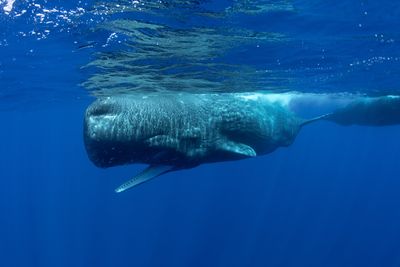
There's a huge possibility space in what sperm whales could be saying to each other.
Dr David Gruber
Plus, we’ve all seen the videos of those dogs using the button mats to express themselves. But instead of teaching a dog English or an ape ASL, could we instead learn to speak whale?
To find out, I talked to Dr David Gruber, CEO of Project CETI (Cetacean Translation Initiative), which is aiming to decode sperm whale language, one coda at a time.
How do you even begin to go about something like this?
Dr David Gruber: I've been a marine biologist my entire career. As a kid, though, I was actually super interested in ants and all the little critters crawling outside of my house, and I just kept going further and further, studying different ecosystems.
I even studied the tropical rainforest in Guyana for a little bit. But I had been kind of seeing a theme in my work, which was trying to use technology to see the world from the perspective of other creatures.
So I was in Boston, Massachusetts, near this old whaling town, and there was so much Melville culture and Moby Dick around. And I was sitting in my office and playing the sound of sperm whale clicks, which are kind of cool because they sound like a machine gun or a jackhammer.
And there was a cryptographer across the hall, Shafi Goldwasser, who came in, and she was just like, "What's going on in here?" And she got really curious about the clicks because, as a cryptographer, they're kind of like ones and zeros.
When you look at the data, you can see that as the whales are talking, they're changing the spacing between the clicks. And coming at this from a natural language processing perspective, where computer science and linguistics come together, we were able to come up with the sperm whale phonetic alphabet, which shows that they're using these clicks on a combinatorial basis [like how], as humans, we could keep combining words together over and over.
And so that was a first start; there's a huge possibility space in what sperm whales could be saying to each other.
Can you tell that one whale is talking specifically to another whale?
DG: Yes, especially if it has a tag on it, because you're hearing the focal whale, and then you'll hear the whales around it. So it still takes a lot of time and annotation, but we're getting better and better and have computers to help the humans parse that out. So the answer is yes, though it's still taking us quite a bit of work.
Can you think of any standout moments while eavesdropping on these whales?
DG: Three years ago in 2023, we were out there listening, and we came across 11 whales from a unit known as unit A. We watched for a while, and 2 hours later, we actually saw a sperm whale giving birth.
We're always asking ourselves how would translating their voices be a benefit to the whales?
Dr David Gruber
We watched and recorded for six hours of the unit members holding the baby above water so the baby didn't sink.
After, it took us two-plus years to design a computer vision software package that could make sense of this. We had to have [Shane Gero] come in and annotate which whale is which and what is their family relationship. We just recently published two papers showing what was one of the most collaborative, empathetic entries into the world of any mammal to date.
What kind of things motivate you in the CETI project?
DG: So we're always asking ourselves, how would translating their voices be a benefit to the whales? And that's even led to a three-plus-year partnership with the More-Than-Human Life (MOTH) Programme at NYU. They're a group of legal scholars that are looking at how this information on other non-human voices could lead to better protections for them.
We're looking at ship noise, for example, and how that's impacting their communication, so we could kind of turn down the volume of some of the noises that could be really bothering them.
But I also don't think this project will ever end. I think the whales are showing us a complexity and a nuance in their voices. And even in what could be going on in their echolocation clicks. We could listen to their voices for 100 years and we'll probably still be learning new things.
So I'm just excited that it's an endless quest to understand an animal that may have had language way, way, way before we had.
If we jump to the future where you've made an interface to truly talk to whales, what's the first thing you would say?
DG: You have just set me up so perfectly for our Listen to the Whale campaign that we just launched in collaboration with National Geographic. Its at listen.projectceti.org and everybody could put in what they might want to share with the whale should it be possible.
There are over 8 billion people on the planet, what would everyone want to say?
Curious to know more? Listen to the full interview here on IFLScience's The Big Questions podcast. You can listen to this episode and subscribe to the podcast on all your favorite podcast apps: Apple Podcasts, Spotify, Podbean, Amazon Music, and more.