Nature
 PUBLISHED


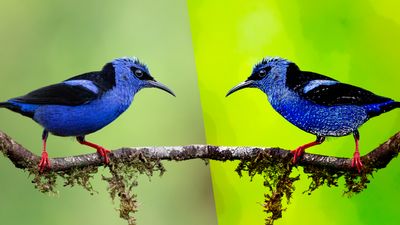


Let’s start with a hypothetical situation. Imagine you’re a bird-watcher. You’ve been out in the field snapping shots of various species, and then you spot a rare bird that just happens to be perched on a branch. You have a clear view, so you’re able to snap a great picture of your feathered prize. But alas, when you get home you notice that rather than being completely clear, the picture is a little out of focus.
Rather than spend ages toying with it yourself, you turn to ChatGPT or Google Gemini, known generative artificial intelligence models (AI), to enhance the image. It now looks great, so you submit it to a popular wildlife photography forum.
Unbeknownst to you, you’ve just introduced a problem that is starting to undermine a valuable relationship that has been emerging between scientists and the public over the last decade.
A "golden age" at risk?
We have arguably been living in a golden age of citizen science. For the last 15 or so years, non-formally trained scientists have played a critical role in gathering data for countless projects. The benefits of this collaboration have, in some cases, been transformative, but this golden age is under threat.
In a new published letter, scientists have urged people to limit their use of AI for editing photos, audio, or video content, as subtle alterations can invalidate their use for scientific research.
At the same time, the researchers raise alarm at the sheer number of fake AI-generated images that are also being uploaded to wildlife platforms that are routinely used for scientific research.
Every year, millions of submissions are uploaded by the public to trusted sites, such as iNaturalist, iRecord, the National Biodiversity Network, and Macaulay Library. The data from these submissions can offer valuable information species numbers and their distribution, we well as their behavior. However, AI-generated or edited content contaminates this information.
Of course, this is not a completely new phenomenon. For as long as humans have been trying to catalog the natural world, some folks have attempted to smuggle fake specimens into the record.
Sometimes they did so as a joke, others as a deliberate attempt to mislead. The famous Fiji Mermaid is a great example here, but there are others like the fur-bearing trout, the Piltdown Man, and Gef the Talking Mongoose.
But AI offers something qualitatively different from these past examples. The ability for users to quickly create ultra-realistic images that can easily convince specialists is an altogether new challenge.
Already, hundreds of fabricated specimens have been identified by eagle-eyed platform moderators on citizen science websites.
“It is unclear at present how pervasive this problem may be, as some or even many such images may go undetected,” the authors write in their letter.
Deliberately misleading images are one thing, but edited content is also an issue. Image enhancement by AI can introduce or even remove content that leads to misidentification of the animal involved. This is because AI draws on the repository of data it has been trained on, which can lead it to overlay what it believes should be present in the desired image.
“In addition to affecting these ‘active’ citizen-science initiatives, many social media platforms are already flooded with AI-generated images of animals, which undermines the long-touted potential of these sites as sources of harvestable ‘passive’ citizen-science biodiversity records,” they added.
There are some solutions to address these growing problems.
Firstly, people need to learn exactly how AI can interfere with their content’s fidelity. They should avoid trusting these tools as quick, easy ways to enhance their images, audio or videos if they intend to upload them to these sites.
At the same time, further safeguards need to be introduced to screen out potentially fake or overly manipulated content. Image authentication is one way to do this.
“iNaturalist has, for example, recently introduced flagging options for submissions that are suspected of excessive manipulation. Images that are fully artificially generated can also be flagged on iNaturalist, and the image will be hidden”.
Given this situation, it is clear that urgent measures are needed otherwise the value of citizen science for biological recording could be invalidated. This would be a significant shame, considering how useful it has been for so long.
The letter is published in Nature Ecology & Evolution.