


 Nature
 PUBLISHED


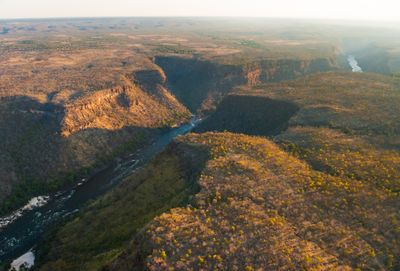


A region known as the Kafue Rift could be the site of the world’s newest plate boundary, as the once stable African tectonic plate cracks up. Scientists exploring the rift have found evidence the boundary has cut all the way through the crust to the mantle beneath, with the conclusion written in the gases found in hot springs along the rift.
Plate tectonics set the continents on an endless dance, and can pull them apart just as it brings them together. The fact that Africa and South America’s boundaries remained a near-perfect fit alerted geologists to the phenomenon, but sometimes the divisions are not so even.
In recent years, a series of rifts in East Africa have become the focus of extensive attention. It is anticipated the widening of these rifts will tear a large chunk of the continent off over millions of years. However, a lesser-known series of rifts, of which the Kafue is part, also crosses the continent, and while currently lagging, may overtake the more famous eastern set.
Not every rift turns into a true plate boundary, but when Professor Michael Daly of the University of Oxford and co-authors sampled geothermal springs and wells in Zambia, they found a ratio of helium-3 to helium-4 more typical of the mantle than crust.
That indicates a direct connection between the mantle and the surface. Although there is at least one place where you can stand directly on the mantle, usually the Earth’s crust is around 40 kilometers (25 miles) thick. If this mantle to surface connection is present along the entire rift, rather than just at a single point, it would mark the formation of a plate boundary.
The rifts the Kafue belongs to run for 2,500 kilometers (1,550 miles) from Namibia to Tanzania. Rifts are harder to track in the ocean, but it is possible Namibia’s Eiseb Rift connects to rifts that run all the way to the mid-Atlantic ridge.
“A rift is a large break in the Earth’s crust that creates subsidence and associated elastic uplift,” said Daly in a statement. “A rift may become a plate boundary, but commonly a rift’s activity ceases before the point of lithospheric break-up and plate boundary formation.”
To explore if the rift has reached the mantle, Daly and co-authors took samples of gas bubbling out of water at eight Zambian sites, six along where the rift runs, and two beyond. The rift gases were primarily nitrogen, and methane, but had unusual amounts of helium. More crucially, within the rift, the helium-3/helium-4 isotope ratios were seven times as high as at the control wells.
The mantle contains both helium-3 and helium-4 from before the Earth was formed. Over time, this has been supplemented by helium-4 produced when radioactive elements release alpha particles that then capture electrons. In the crust, however, almost all the helium is from alpha-decay, leading to much lower isotope ratios.
To confirm the conclusion that the helium was coming from the mantle, the authors tested the carbon dioxide in one well, and found carbon-12/carbon-13 ratios indicative of mantle contamination.
Helium is valuable for much more than party balloons, and the loss of a major source is one of the lesser-known problems posed by the partial closing of the Strait of Hormuz. Abundant helium from the East African rift has been proposed as a solution to the world’s shortage of the lightest noble gas. The authors note that early stages of rifting may be accompanied not only by commercial quantities of helium, but uncontaminated hydrogen and geothermal heat suitable for electricity generation.
Although the Kafue rift is much less advanced than the East African break – some of which has reached the necking stage – Daly thinks it could develop faster.
“Many of the features of the Great Rift Valley of Kenya offer compelling reasons why East Africa should ultimately become a line of major continental break-up,” said Daly. “But the rate of rifting of the East African Rift System is slow. On almost all sides of Africa there are mid-ocean ridges tending to inhibit east-west or north-south extension, so break-up and spreading does seem to struggle to establish itself.”
“The Southwestern African Rift System could be an alternative,” Daly continued. “It has the required rift-related features, and regional basement fabrics – inherent weaknesses in the crust – favorably aligned to the surrounding mid-ocean ridges and continental geomorphology. This relationship may offer a much lower strength threshold for continental break-up.”
Nevertheless, Daly is keen to stress this is a possibility, not a certainty, noting: “This study is based on helium analyses from one general area in the Southwest African Rift System, which is thousands of kilometers long.” A rift that only touches the mantle over a small area may never develop into a full plate boundary, or at least take much longer to do so.
Researchers are collecting data from other parts of the rift system to see how far the mantle helium signature extends, and therefore if a plate boundary already exists.
The study is published in Frontiers in Earth Science.



 1
1