


 Nature
 PUBLISHED



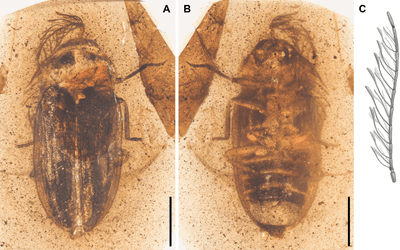


A remarkably preserved 100-million-year-old fossil beetle has been discovered with both a fully intact light-emitting organ and a structure scientists have never seen before.
The fossil is preserved in amber from Kachin in Myanmar, and dates back to the Cretaceous Period. Analysis of the specimen reveals that not only is it a member of the Coleoptera, which includes all beetles, but that it belongs to the extinct family Cretophengodidae, which is similar to fireflies and their relatives.
The fossil, now named Icaroramus perisi, represents a new genus of Lampyrid beetles. But in addition to being able to flash from its rear, what got researchers most intrigued was its super unusual antennae.
These antennae have 12 segments, and each segment has two pairs of what's known as lami, or branches, that look different in each pair. “Its 12-segmented quadriheteroramose antennae represent an antennal architecture unknown among extant and fossil beetles,” write the authors.
.png "An artist reconstruction of what the beetle might have looked like.")
It is thought these well-developed antennae would have been used to find mates by sensing chemical communication through the pheromones in the air. It's even possible that the different parts of those funky antennae allowed the beetle to distinguish between different chemicals and pheromones.
Interestingly, fireflies alive today typically have simple antennae and light signals, whereas Icaroamus had fancy antennae and light-emitting organs. Because of this unusual combination, the authors think that the light might have been used as a predator defense rather than for mate signaling and courtship.
Because of the age of the fossil, it shows that early in the evolutionary history of these insects light signals and antennae for chemical recognition had already evolved even 100 million years prior to the living insects we see today.
This is the second firefly-like fossil to be discovered from Myanmar this year. In May, a new species called Cretoluciola birmana was described as a member of the “true Luciolinae fossil from the mid-Cretaceous."
In 2023, a microwasp was also discovered with such funky antennae that it might have struggled to fly. “The unique, miniature cloudlike structures stuck to the antennae must have certainly been an annoyance to this tiny parasite,” hypothesized George Poinar, lead author of the study in a statement at the time.
The antennae structure seen in Icororamus perisi has never been found on another species, living or dead, and is unique to this species, revealing just how complex the beetles communication was even back in the Cretaceous.
The paper is published in Proceedings of the Royal Society B.




 1
1