Nature
 PUBLISHED



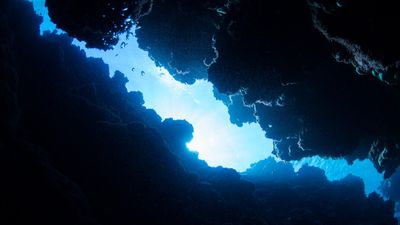


A team of scientists has investigated the so-called "Grand Canyon of the Atlantic": A huge underwater canyon extending 500 kilometers.
In the North Atlantic, around 700 kilometers north-northeast of the Azores Archipelago, is an area of canyon-like troughs known as the King's Trough Complex. The eastern end of the complex is one of the deepest areas of the whole Atlantic Ocean.
"The most prominent basin is the eponymous King's Trough, which is about 350 km long and up to 80 km across," the new paper, which describes how researchers thoroughly mapped the area for the first time, explains. "Linear ridges or elongated seamount-like structures flank both sides, including the Antialtair Seamount on the SW flank, resulting in an overall relief of more than 4,000 m along just ∼15 km lateral distance."
Canyons on Earth's surface are easier to explain. The Grand Canyon, the go-to canyon example, was carved out by the Colorado river cutting through the uplifting Colorado Plateau. Underwater canyons aren't forged by the same process (though neither are some above-ground ones) and remain poorly understood.
Scientists have been debating the origin of the complex for around five decades, but it has only been investigated sporadically during that time, with rock samples taken from just a few sites. In 2020, the team behind the recent research mapped the site using sonar and collected samples through dredging. They also combined another expedition's map with their own to create the first "detailed and comprehensive picture of the morphology" of King's Trough, as well as measuring the age of the samples collected from the ocean floor.
“Researchers have long suspected that tectonic processes – that is, movements of the Earth’s crust – played a central role in the formation of the King’s Trough,” lead author Dr Antje Dürkefälden, a marine geologist at GEOMAR in Kiel, Germany, said in a statement. “Our results now explain for the first time why this remarkable structure developed precisely at this location.”
According to the team, between 37 and 24 million years ago, a plate boundary ran through this area of the North Atlantic, and along that boundary the crust became stretched and fractured. That isn't the whole story, however, and the team believes thicker crust in the area may also have played a role in the complex's formation. This could have been caused by a mantle plume, a colossal upwelling of molten rock from deep inside the planet.
"Based on seismic and gravity data, Searle and Whitmarsh assumed that this elevated area consists of thicker than normal oceanic crust […] which could have been produced at the MAR [Mid Atlantic Ridge] due to raised upper mantle temperatures caused by a mantle plume," the team explains in their paper. "Conspicuously, a melting anomaly is still observed on the MAR at ∼45°N located roughly in the center of this elevated area and termed the 45°N anomaly."
The researchers suggest that the mantle plume was likely an early branch of the Azores mantle plume, and it was this that weakened the area.
"This thickened, heated crust may have made the region mechanically weaker, so that the plate boundary preferentially shifted here,” co-author Dr Jörg Geldmacher, marine geologist at GEOMAR, added. "When the plate boundary later moved further south towards the modern Azores, the formation of the King’s Trough also came to a halt."
While interesting and necessary to figure out the past geology of the complex, the findings could also tell us how other areas might evolve in the future, such as the nearby Terceira Rift, which is also thought to show signs of thicker crust.
The study is published in Geochemistry, Geophysics, Geosystems.