Nature
 PUBLISHED




What you'll discover in this article
- New research suggests mammals made crossings between North and South America for millions of years, by swimming and rafting before there was ever a land bridge.
- Most of this movement was from north to south, particularly before the continents joined, during which time only sloths went the other way.
- First author Professor Jack Tseng told IFLScience that "the North American mammals who made it south were seasoned veterans at the 'survival of the fittest' game, versus evolutionarily more inexperienced South American mammals."
The greatest pre-human exchange of animal species in the history of the world didn’t all happen at once. New research argues that although it only became possible to walk between the continents 2.8 million years ago, animals had been swimming and rafting between for millions of years, gaining a jump on their counterparts.
The way that North and South America connect is a remarkable coincidence, but one with vast implications for the ecology of both.
For tens of millions of years, the ecosystems of South America evolved in almost complete isolation, while North America occasionally connected to Asia through a link cold-adapted species could cross. Once the two came in contact, a process known as the Great American Biotic Interchange (GABI) took place as animals and plants flooded into new potential homes.
Yet the GABI timeline has puzzled biologists. Some species made the crossing earlier than others in ways that have been difficult to explain.
This has led to the hypothesis that there was not one GABI, but several smaller ones, with land bridges rising and falling multiple times before the Isthmus of Panama finally established itself.
A more detailed analysis of the arrival times of new families of mammals on each continent argues the land connection only happened once, but some species jumped the gun by making sea crossings.
“Our study demonstrates for the first time that not only was there a set of significant pre-GABI phases that are different from the traditional Great American Biotic Interchange events 3 million years ago, but that this ramp up is much older than people thought or imagined,” said Professor Jack Tseng of the University of California, Berkeley in a statement.
“The ramp up began at the latest about 10 million years ago.”
Tseng told IFLScience, “Around the 10 to 7 million year mark, we detected an increase in dry environment vegetation in our geochemical data. This finding suggests that a shift in the general vegetation and environment in Mexico at around 10 million years ago may have facilitated a spike in mammal movements down south from northern North America.”
He acknowledged, however, that the process may have started earlier, hidden by an incomplete fossil record.
Combining fossil records with molecular clocks that reveal when animals diverged, Tseng and co-authors conclude that many mammals previously restricted to what is now the United States and Canada moved into Mexico from 10 to 7 million years ago.
These pioneers couldn’t have known that their initiative would provide an even greater reward for their descendants down the track, but around 7 million years ago some of the smaller mammals started finding their way to South America.
The route these animals took remains unknown. Perhaps they swam from island to island through the Caribbean, including some waystations that no longer exist. Alternatively, they may have rafted on vegetation washed out to sea. After all, we know that monkeys made the much longer journey from Africa to South America and weren't alone.
The North American mammals who made it south were seasoned veterans at the 'survival of the fittest' game.
Professor Jack Tseng
“Mexico was not a completely unique geographic region that was generating new species that then dispersed south when the land bridge appeared,” Tseng said in the statement. “It really is just a geographic extension of what we already see farther north in North America.”
That may seem unsurprising to someone looking at maps – millions of years before there was a wall between Mexico and the United States, we might expect animals to cross freely. However, the climate of the two was sufficiently different that, prior to 10 million years ago, their inhabitants were very different.
Quite how species used to cooler climates farther north made it into Mexico remains unknown, but Tseng and co-authors suspect there were grassland corridors cool enough for them to follow.
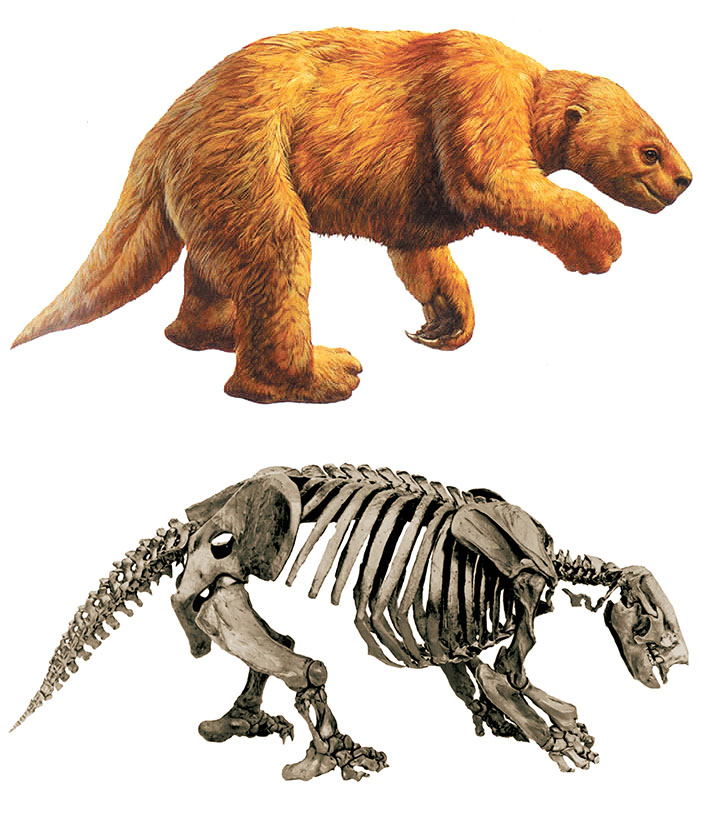
One thing the authors are confident about is that this trans-oceanic exchange was mostly one way, with many families traveling north to south, while only the sloths left evidence of the reverse.
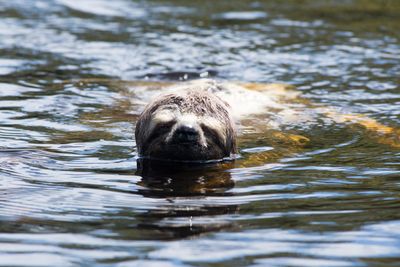
If one wanted to back one suborder of animals to complete a migration others cannot, sloths probably wouldn’t be many people’s pick. However, Tseng told IFLScience, “Living sloths are known to be good swimmers, and some fossil sloth lineages have even been interpreted as mostly aquatic. So, this lineage seems to have the right combination of physiological characteristics to make it.”
About 2.8 million years ago, “the floodgates opened and essentially northward and southward dispersals by mammals were unimpeded, as far as we know,” Tseng said in the statement. The Darién Gap may be a formidable barrier for individual humans to cross, but compared to a stretch of ocean it’s a walk in the park.
Nevertheless, the previous preponderance of mammals going north to south proved indicative of what was to come. Ungulates like tapirs and camelids like llamas made the south their home, along with numerous rodents, but few made it the other way.
Plants and flying animals (insects, birds, even bats) were much less restricted by the lack of a permanent land bridge between the Americas than the terrestrial mammals.
Professor Jack Tseng
Tseng and co-authors attribute this to marsupials – which made up many of the pre-GABI south’s mammals – not being able to breed as fast as placental mammals, whose young become independent earlier. “That kind of life history strategy likely gave placentals an upper hand in the face of competition with marsupials,” Tseng said.
Marsupial fans have long disputed that explanation, and Tseng told IFLScience, “I have the utmost respect for marsupial mammals.”
“Another reason could be that whereas South America has been isolated as a continent for most of the 'Age of Mammals' (the time period of the past 66 million years), their North American counterparts frequently competed with species from Asia via the Beringian land bridge connection. In this sense, the North American mammals who made it south were seasoned veterans at the 'survival of the fittest' game, versus evolutionarily more inexperienced South American mammals.”
The study focussed on mammal movement, but Tseng told IFLScience, “Other studies have shown that plants and flying animals (insects, birds, even bats) were much less restricted by the lack of a permanent land bridge between the Americas than the terrestrial mammals.”
In an age where species sometimes cross oceans in the holds of airplanes, understanding the forces that allowed some to flourish and others to fail in their new homes could help us know what is to come.
The study is published in Science.

 1
1