Nature
 PUBLISHED





What you'll discover in this article
- The first new species of cat has been described in more than 100 years.
- Leopardus tilcayo is known from just two individuals, including a cat called Tilcayo that has lived at a wildlife sanctuary since 2017.
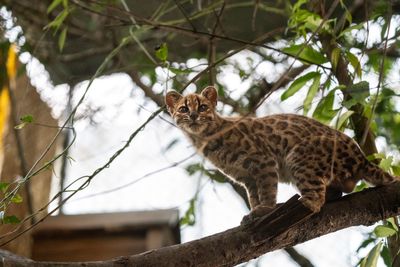
- “If you saw the cat, it's smaller than a domestic cat. And the ears are really rounded like a teddy bear, it's really beautiful,” study author Paola Nogales Ascarrunz told IFLScience.
The tiger cats are one of the shyest, most cryptic groups of animals. They're all smaller than domestic house cats and live secret lives within the jungles and grasslands of South America.
Now a new species has joined the party, based largely on a single animal that lives in a sanctuary in Bolivia named Tilcayo.
Study co-author and National Geographic explorer Paola Nogales Ascarrunz first encountered Tilcayo at the Senda Verde Wildlife Sanctuary, Bolivia, where she was volunteering. The cat had arrived at the sanctuary after being kept as a pet by a local family, and since he was semi-domesticated, couldn’t be returned to the wild.
“If you saw the cat, it's smaller than a domestic cat. And the ears are really rounded like a teddy bear, it's really beautiful,” Nogales Ascarrunz told IFLScience.
The first signs that it might be a new species began to emerge as Tilcayo did not fit the description of Leopardus tigrinus, also known as the northern leopard cat or the oncilla. In fact, it more closely resembled Leopardus guttulus, or the southern tiger cat.
But this didn't make sense, as the southern tiger cat is found in Brazil and was not known to live in Bolivia.
.jpg "Paoloa and Tilcayo look at each other inside the sanctuary.")
Uncertain genetics
To be sure of what species Tilcayo was, Nogales Ascarrunz ran some genetic tests. But here she hit a snag: the results didn't match anything she knew of.
“With my colleague we took some samples of the hair and also some saliva to do some analysis,” Nogales Ascarrunz told IFLScience. “And then I messed it up, my results didn't make any sense, it didn’t match to Leopardus tigrinus it matched to another species, so then I thought what did I do wrong?”
I would like to get a message to people that we still have so much to discover. So we just need to look around at what we have, we still have so many species to describe.
Paola Nogales Ascarrunz
Convinced the sample was contaminated or something had gone wrong with the DNA analysis, the results stayed put. That was until years later, when Nogales Ascarrunz returned with better knowledge of DNA processes to run both the mitochondrial and nuclear genomes again to find out what was really going on with Tilcayo’s genetics.
The results were interesting, to say the least. Comparing the results to the known genomes of tiger cat species and DNA taken from museum specimens revealed that Tilcayo belonged to a brand new species.
While the related cat Leopardus pardinoides was promoted from a subspecies to a full species in 2024, according to the authors, this represents the first entirely new cat species to be described in more than 100 years.
“When the results came, it was amazing because for cats, you have a timeline that is 1 million years long, explains Nogales Ascarrunz. “So if a species of cat diverged more than 1 million years ago, it's another species.”
“When we saw Leopardus tilcayo, they diverged 1.4 million years ago. So it's a really, really long time ago that this cat diverged from Leopardus tigrinus and Leopardus pardinoides. So we were really, really happy about it because it really was a new species for science.”
Cryptic cats
One of the reasons why this species has remained elusive for so long is in part because of the misidentification of specimens in museums and on camera traps.
For example, Nogales Ascarrunz found one museum specimen labelled as L. trigrinus, but it turned out to be a totally different species known as a margay. To the untrained eye, the species are very difficult to tell apart, that is, if you’re lucky enough to spot one in the first place.
The new Leopardus tilcayo differs from the other tiger cats by having larger rosettes and a longer, less bushy tail. Overall, the species measures 42.5 to 50.5 centimeters (16.7-19.6 inches) from its head to the end of the body, with a tail length of 25 to 26.5 centimeters (9.8-10.4 inches).
With the inclusion of Leopardus tilcayo, this means there are now 5 species of tiger cats in South America, plus a smattering of subspecies. When asked if there could be more species out there, Nogales Ascarrunz said there could be more in Argentina and will continue looking at museum specimens to help work out the distribution of all of these species.
“I would like to get a message to people that we still have so much to discover,” says Nogales Ascarrunz. “So we just need to look around at what we have, we still have so many species to describe.”
The paper is published in Current Biology.