Nature
 PUBLISHED





When viewed from space, Earth appears to be totally spherical, as smooth and perfect as a little blue marble. In reality, however, it’s more akin to a gnarly potato, squished flat at the poles and bulging at the equator. But this odd shape isn't set in stone either.
From a human perspective, the planet seems rock solid, coated in a thick crust of tough and immovable material. However, its shape is constantly changing, albeit very, very slowly, through natural processes like melting ice, tectonic shifts, and changes in the Earth's interior.
Welcome to the world of geodesy
Welcome to the world of geodesy, the science of measuring the geometric shape, gravity field, and spatial orientation of Earth.
Geodesists have been measuring the changes in Earth's shape since the 1970s, primarily using satellites and lasers to measure tiny gravitational variations.
In a new study, one geodesist from the Aristotle University of Thessaloniki in Greece attempts to see whether similar findings could be gathered using another method involving GPS.
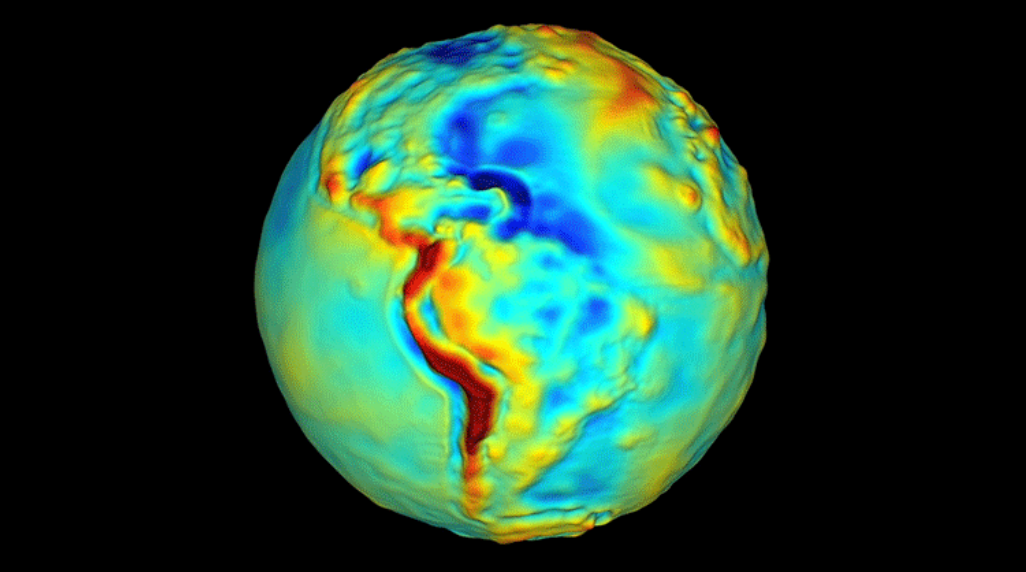
The new data suggest Earth's physical shape is becoming slightly less flattened. Between the late 1990s and 2015, uplift at the poles roughly doubled, climbing from about 0.5 millimeters per year to close to 1.0 millimeters per year, while the equatorial belt sank at a comparable rate. The result is a slightly rounder planet.
This trend is ultimately caused by polar ice loss. The icy regions of Earth around the North Pole and South Pole have been thawing in recent decades as a result of rising global temperatures.
Melting polar ice redistributes mass (in the form of liquid water) from the poles to elsewhere in the planet’s oceans, like the equator. This eases the load at the poles, letting the crust there rise, while adding load near the equator, pressing the seafloor crust down.
"Our results indicate an acceleration of polar uplift accompanied by a comparably increasing rate of equatorial subsidence," the study reads.
"This means that solid Earth's overall shape is becoming slightly less flattened."
Gravity tells another story
Interestingly, gravity measurements show the story from a different perspective. This data shows where the mass itself has ended up in the Earth–ocean system as a whole; the poles are losing mass, while lower latitudes are gaining it. This is accurate, but it doesn't capture how the physical crust's actual shape is responding to that shift.
In other words, the mass piling up near the equator makes the gravity field bulgier there. However, the physical ground in that same region is doing the opposite, becoming pressed down and dented by the extra weight, not puffed outward.
“We further find that this geometric change is not fully mirrored in the Earth's gravity field, indicating that the geometric response of the solid Earth and the gravity field response to mass-redistribution do not evolve identically,” the study concludes.
Time trouble for the changing planet
Whatever way you look at it, Earth is changing shape, and that could have some significant consequences in the near future.
The planet’s changing shape is also impacting how it rotates in orbit, which is set to change the length of an astronomical day and mess with our global timekeeping conventions.
The impact may be so severe that some scientists have even suggested that Coordinated Universal Time will need to receive a negative leap second – a minute with just 59 seconds – sometime around 2029.
The study is published in the Journal of Geophysical Research: Solid Earth.