Nature
 PUBLISHED





Gravity across Earth is pretty reliable. Drop a ball on the ground in England, fly to Australia, and drop the ball again, and you will find they fall to the ground at pretty much the same rate.
But we stress "pretty much" for a reason: gravity across the planet isn’t entirely uniform, and its strength depends on the distribution of mass and where you are in relation to it.
This is like how the Moon's gravity is stronger on Earth than Jupiter’s is, despite Jupiter being some 26,000 times more massive than the Moon. The reason is that the Moon is much closer; likewise, more gravity is exerted on you when you are closer to a large amount of mass on Earth.
For example, Earth bulges slightly at the equator thanks to its rotation, making it an oblate spheroid rather than a true sphere. As a result, you weigh slightly more at the North Pole, where you are closer to the bulk of Earth's mass, than you do at the equator, where you are further from it.
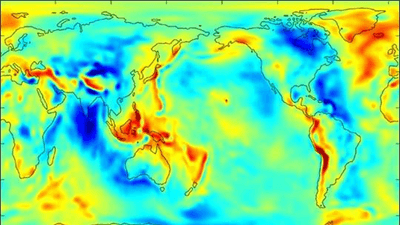
Scientists, including those at NASA's Gravity Recovery and Climate Experiment (GRACE) mission, have attempted to map Earth's gravitational field as thoroughly as possible. To do so, GRACE used highly sensitive satellites that were separated by 220 kilometers (137 miles).
"GRACE measured gravity by relating it to the distance between the two satellites. When there was an increase in gravity ahead of the pair, the front satellite sped up and the distance between the pair increased," NASA explains.
"When the increased gravity was between the pair, their distance decreased; the opposite occurred when there was decreased gravity ahead of, or between, the satellite pair."
Using this technique and others (such as using spring-based gravimeters on the ground) researchers have spotted several "gravity anomalies", or places where gravity differs from what we would expect of that region, given what we know of the area.
For example, in the Hudson Bay area of Canada, you will weigh a tiny amount less than on other parts of the planet. It's not much – around four-thousandths of a percent less than at the average location on Earth’s surface – but it took quite a lot of research to explain why.
Of course, the basic cause was always known; the region must be "missing" some mass compared with other parts of the planet. Researchers determined that this is likely caused by a few factors, including events during the last glacial period, commonly called the last Ice Age.
It was during this time that the Laurentide Ice Sheet that covered most of Canada pushed through the country, shoving dense rock out of its way and compressing it down below. When the ice sheet melted, it left the area with missing mass, which is now slowly recovering.
However, that only accounts for around 25-45 percent of the gravity anomaly seen at Hudson Bay, according to an analysis of the GRACE satellite data. The remaining anomaly is likely caused by activity well below the surface. The rising and falling of magma, for instance, creates convection currents that can drag down continental plates, decreasing the mass in the area and making gravity ever so slightly weaker there.
The biggest negative mass anomaly on Earth, where gravity is weaker compared with elsewhere, is at the Puerto Rico Trench. There, gravity has been measured at around 380 milliGal less than we would expect it to be.
Investigating the anomaly in 1977, geophysicist Peter Molnar found that previous models of gravity had assumed that the thickness of Earth's crust was fairly uniform. Looking at the area, however, he realized that wasn't the case and the anomaly was more than likely caused by a large and dense "hanging flap" of the Atlantic lithosphere underneath the trench.
But where is the place on Earth's surface where gravity is actually weakest, rather than only weaker than we'd expect?
Given what we know about mass and gravity, places like the peak of Mount Everest would be a reasonable guess, given that the world's tallest mountain keeps you a fair distance from all that mass below. But the weakest gravity measurements at the surface are actually on Mount Nevado Huascarán in Peru, where the acceleration due to gravity is measured at 9.7639 meters per second squared, due to a combination of factors.
"Nevado was a bit surprising because it is about 1,000 kilometers [620 miles] south of the equator," researcher Christian Hirt told New Scientist in 2013. "The increase in gravity away from the equator is more than compensated by the effect of the mountain's height and local anomalies."
So, if you want to weigh the least you possibly can, whilst still standing on Earth and without losing any of that hard-earned mass, you should head to the top of Mount Nevado Huascarán in Peru, though the differences will still only be teeny tiny.