Nature
 PUBLISHED


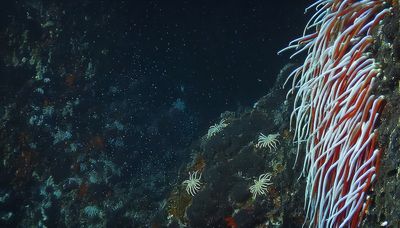


The presence of microplastics has reached possibly the most remote ecosystem in which life is abundant: where lifeforms thrive on the energy and nutrients from hydrothermal vents. A sample of animals living around these vents found 92 percent contaminated with microplastics.
The viral claim that you eat a credit card’s worth of microplastics a week may be wrong, and there probably isn’t a teaspoonful in your brain, but one truth about microplastics is how ubiquitous they are. There’s almost no place on Earth you can escape the tiny particles of plastic released when larger pieces degrade, or sometimes just get washed.
Following the discovery of microplastics in Antarctica and long-closed caves, Dr Se-Joo Kim and Dr Jinyoung Jeong of the Korea Research Institute of Bioscience and Biotechnology led a team to explore conditions on the deep ocean floor.
“Within this vast abyss, hydrothermal vent ecosystems stand out as biological oases,” the team writes in a new study. The researchers collected provannid snails and modiolid mussels that live around vents in the Central Indian Ridge and the Pacific’s North Fiji Basin, and examined them for microplastics.
At just 3.4 particles per organism, the contamination was low compared to most other life, but the fact that 11 out of 12 individual organisms had at least one microplastic particle shows that nowhere is safe.
More than half (56 percent) of the plastic was polystyrene, showing we will be paying the price for cheap packaging and insulated throw-away cups for a long time to come. In contrast, surface plastic is more likely to be polyethylene or polypropylene. Particle sizes ranged from 81μm to 1.2mm.
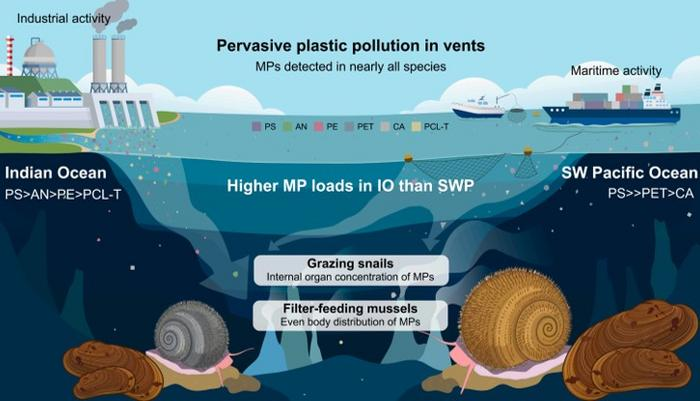
In snails, the particles were primarily found in the digestive system, but the filter-feeding mussels had distributed them through their bodies, a pattern that has also been seen in coastal species.
Concentrations were much higher in the Indian Ocean than the Pacific, with 1.9 times as many particles per specimen and 3-15 times as many per gram of bodyweight, depending on taxonomic class. This may reflect the way ocean circulation concentrates pollutants at specific points as well as the relative inputs into the two oceans.
The abundance of plastics on the ocean surface has drawn plenty of attention, but since most plastics float, it was possible to hope the deeper ocean would be spared.
"Plastic pollution has now spread even to deep-sea hydrothermal vent ecosystems that were once considered among the most isolated environments on Earth," Kim said in a statement.
"Our findings provide important scientific evidence for establishing future deep-sea environmental monitoring systems and conservation policies."
The study is open access in Water Research.