Nature
 PUBLISHED
 1
1



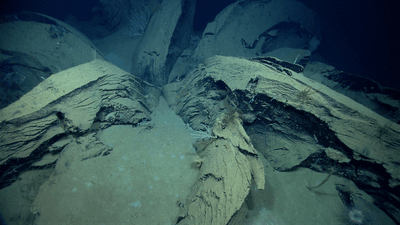


We tell everyone the “S” in IFLS stands for science, but some days, it stands for shipwrecks. There’s surely no greater deep-sea expedition than going in search of lost vessels and the artifacts they may contain – that is, except for when your dive gets hijacked by a giant alien flower.
The year is 2014, and scientists with the National Oceanic and Atmospheric Administration (NOAA) are on a dive in the Gulf of Mexico. Data from a side-scan sonar had revealed a cluster of large structures at a depth of 1,900 meters (6,234 feet). Everyone’s shipwreck senses are tingling.
Such a reading is like catnip to ocean researchers who know it’s unusual to find such large solid structures on the seabed. Then again, if centuries of ocean exploration have taught us anything, it’s that you never know what you’re going to find lurking beneath the waves.
Flowers of the deep
Close inspection of the object revealed it wasn’t a human-made structure at all, but something that had seeped through cracks in the seabed from deep inside the Earth.
These structures are known as tar lilies – rare flower-shaped lumps of rock made of hardened asphalt appearing to crawl out of the seabed (although there are real underwater flowers in shallower regions, if you know where to look).
If you’ve ever walked along a road, then chances are you’re familiar with asphalt. Humans have manufactured our own version blended with rock and sand to create concrete, but it also occurs naturally on the seabed.
That’s because there are underground petroleum reservoirs that can rise to the surface. Like a kind of deep-sea volcano, except it's erupting tar into the environment, rather than molten rock.
As these leakages hit the cool seawater, they harden. Sometimes, this paves the sea floor in solid asphalt, but at other times it creates bizarre rocky sculptures like this massive tar lily.
To us it looks like something escaping out of Stranger Things, but for wildlife it’s prime real estate.
“The presence of chemosynthetic organisms (tubeworms, microbial mats, and shrimp) indicated that hydrocarbon seepage was actively occurring,” said the NOAA in a release.
“The hard ‘petals’ of the structures provided habitat for other organisms, including anemones, sponges, barnacles, octocorals (bamboo corals and sea pens), and squat lobsters.”
An ocean of surprises
The discovery was remarkable not only for the size of this impressive tar lily, but also because they were not known to occur in this area of the Gulf. Other highlights from the expedition included the discovery of a real shipwreck complete with chronometer – a timepiece the NOAA says is rare for an early 19th-century vessel.
On the organic side, exploration of Keathley Canyon revealed Paleodictyon burrows, a fossil we’ve found on cliffs and the seabed and still don’t know what it is from, while a dumbo octopus put on quite a show with a body posture that had never before been observed in cirrate octopuses (which are known to be less intelligent than their incirrate relatives).
So, it just goes to show that you really never know what you’re going to find on a deep-sea dive. Sometimes it’s a shipwreck. Sometimes it’s a tar lily. Other times, it’s a herd of washing machines.