Nature
 PUBLISHED





There’s a new organism on the block, and it’s seriously blurring the lines between what we know about life.
This previously unknown little microbe has the smallest genome ever found, and while it resembles a virus, it can replicate and express its own genetic information.
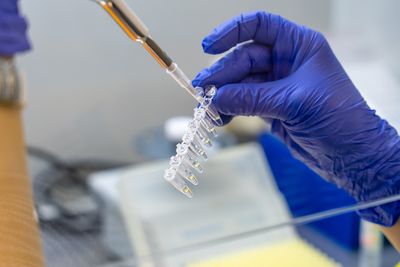
The microbe, currently named Candidatus Sukunaarchaeum mirabile (or Sukunaarchaeum for short) after a small Japanese god, was discovered by accident while researchers were sequencing the genome of Citharistes regius, a marine plankton.
While sampling the plankton, the team bafflingly kept identifying the same loop of DNA that didn’t match any known species. This suggested there was something else living inside the plankton.
Not a virus and not a bacterium, but something else entirely
This turned out to be the mysterious Sukunaarchaeum, which belongs to the archaea, a group of single-celled organisms that are completely different from bacteria. It has an incredibly small genome, consisting of just 238,000 base pairs, which is around half the size of the next smallest known archaeal genome.
Like a virus, Sukunaarchaeum is a single-celled organism that relies on its host for many of its biological functions. For instance, it has lost almost all the genes needed to make its own nutrients and energy. And yet despite this, Sukunaarchaeum still contains genes that allow it to copy its own DNA and use its genetic information to make proteins – something a virus cannot do.
“The key to defining life is whether something can replicate itself, and whether it can do this autonomously”, Professor Thorsten Allers, from the School of Life Sciences at the University of Nottingham, explained in a statement.
“This exciting discovery provides new clues about how simple a living cell can become while remaining capable of reproducing and maintaining its own genetic information.”
The microbe is also genetically different from other archaea. Related genetic sequences found in marine samples indicate that it is part of a much larger group of organisms that has been overlooked.
When organisms have extremely small genomes, they have usually given up some of the abilities they need to function independently. Mitochondria and chloroplasts are good examples of this. Once upon a time they were both free-living bacteria, but now they only exist inside cells where they rely on their host for some of the machinery they need to copy and use their genetic information.
In contrast, Sukunaarchaeum does things differently.
The smallest genome needed to stay alive
“Although it has lost almost all of the genes needed to make nutrients and energy, it has kept much of the machinery required to copy its genome and produce proteins from its genetic information,” Allers added.
“This suggests that Sukunaarchaeum may be close to the minimum level of genetic information needed for an organism to remain an independent cell.”
Interestingly, a quarter of its genome consists of genes for creating unusually large membrane proteins. At present, the researchers don't know what function they serve, but they note that similarly large membrane proteins have been found in some parasitic archaea.
It’s possible that Sukunaarchaeum may live as a parasite on its own or alongside other organisms.
There are still plenty of unknowns surrounding this creature. While Allers and colleagues have identified its genome, they have not yet actually observed it or identified its host. The team plans to learn more about this baffling microbe, including investigating where it lives, what it depends on, and how it interacts with its host.
The results may well tell us more about the limits of life and just how little genetic material an organism needs to survive and reproduce. This information may help us understand how complex life on Earth first appeared, a mystery that impacts how animals, plants and fungi evolved.
The paper is published in Current Biology.