


 Nature
 PUBLISHED


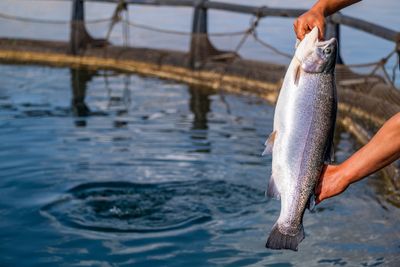


Consumers in Europe might soon be eating salmon that has been grown on chicken.
As the market prices for wild fish meal and oil continue to rise exponentially, European fish farmers have been looking for other sources of cheap protein and have alighted upon the chicken industry.
As reported in the Financial Times, one of Norway’s biggest salmon producers, Lerøy Seafood Group, has already started feeding their fish chicken byproducts. Salmon produced by the company is sold in UK supermarkets.
“Salmon are carnivores and eat other fish in the wild, so feeding them chicken is entirely natural,” an executive at a major salmon-feed producer told the Financial Times.
While salmon are indeed carnivorous fish, claiming that chicken is “natural” for them to eat might be stretching things a little too far for a fish that spends the majority of its life in a marine ecosystem.
The practice of feeding livestock byproducts to fish was banned in the UK over fears of a repeat situation seen with bovine spongiform encephalopathy. This ban was only lifted in 2013.
The cost of farmed fish
On the surface, farmed fish would seem like the obvious solution to the problem of overfishing. But perhaps paradoxically, farmed salmon relies on an extraordinary amount of wild-caught fish to sustain the industry.
The problem comes because salmon are predatory fish that require large amounts of prey fish to grow. A five-year investigation published earlier this year by the Outlaw Ocean project and reported in the Observer described the situation as “ruinous”.
Taking up to 4 kilograms (8.8 pounds) of wild fish to produce 1 kilogram (2.2 pounds) of farmed organic salmon, the industry that proclaimed to be the solution to overfishing is instead a huge driver of the depletion of wild fish stocks.
This has seen not only decreases in wild fish numbers, but also a negative knock-on effect on the local people in the countries that are exporting all their fish as meal and oil for the salmon industry.
But this reliance on wild fish is now coming at a cost. As the stocks continue to tumble, the salmon fisheries have had to contend with a steadily increasing price for fish meal to feed their livestock.
The growing El Niño in the Pacific Ocean has now added to that pressure, as the anchovy fisheries off the coast of Peru that provided a significant source of wild fish have collapsed almost overnight.
New source of protein
This has led to some European salmon farms turning instead to another source of cheap animal protein: chicken.
It is important to note here that this isn’t necessarily a new development. According to the Financial Times, salmon farms in Canada and Chile are already known to use chicken meal to feed their fish.
But in Europe as a whole, and the UK specifically, there has been a wider public taboo around this practice. It now seems that the largest European fish farming companies are willing to break that taboo in the face of rising costs.
The Lerøy Seafood Group isn’t alone in this switch, as the largest salmon supplier to UK supermarkets, Mowi, is also reportedly planning to introduce chicken meal to its fish farms.
The byproducts from the chicken industry include things like bones, liver, and brain. It is unlikely that consumers will know if the salmon they are buying has been raised on a poultry diet as it is currently not required for producers to state this.

 1
1