Nature
 PUBLISHED


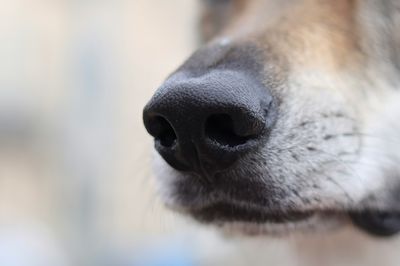


Dogs’ capacity to respond to chemical signals given off by humans is widely documented, and shapes their ability to read our emotional cues. Yet while this remarkable interspecies connection is often explained as the product of thousands of years of domestication, new research shows that even wolves can pick up on the smell of our fear.
Previous studies on pet dogs have demonstrated that the animals modify their behavior and even experience an increase in heart rate when they sniff fear-related chemicals in human sweat. And because this effect has been observed in puppies as well as adult pooches, researchers believe that the ability to respond to our so-called "chemosignals" may be genetically hardwired rather than learned through training or exposure.
What’s less clear, however, is whether this genetic sensitivity to human chemical signals arose during the domestication process, or was already present in the wild ancestors of our pugs, poodles, and Pomeranians.
To find out, the authors of a new study collected sweat samples from 10 women immediately after they had watched either a relaxing nature documentary or a horror movie. These armpit swabs were then presented to a group of 11 dogs and eight wolves, all of whom had been born and raised in captivity and were therefore socialized to humans.
One by one, the animals were presented with a pair of samples, one of which contained horror-movie sweat while the other lacked these fear chemicals. Overall, the dogs and wolves showed no clear preference when choosing which sweat to sniff, but displayed strikingly similar behaviors when the fear-soaked samples were present.
Specifically, both animals spent less time near the sweat samples and looked at their handler more when placed in an enclosure containing the scent of human fear.
“The reactions shown when fear rather than just neutral smell was in one of the targets were similar between dogs and wolves in almost all behaviours,” write the researchers.
“This study adds to the growing evidence that many animals may be able to pick up on subtle, unconscious human communication cues,” they add, suggesting that this capability may have arisen in canids long before we befriended dogs.
However, because the wolves in this study had been reared by humans, these results can’t be used to make any assumptions about the ability of wild wolves to respond to these cues.
“We are thus not making any claims about wild wolf behaviour, but rather stress that under the same life conditions, dogs and wolves show a similar sensitivity to human fear smell,” explain the study authors.
This, in turn, hints at deep evolutionary roots for this responsiveness to human chemosignals, and “suggests that that domestication may not be the main driver for dogs’ (and other domesticated animals’) sensitivity towards heterospecific fear smell,” conclude the researchers.
The study is published in the journal Animal Cognition.