Nature
 1
1




Even as our planet undergoes this latest mass extinction event, it’s hard to argue it’s some kind of barren wasteland. Objectively, there are countless lifeforms around us. It’s just that many of them – so many, in fact, as to round out to 100 percent of them – are too small to be seen with the naked eye. They’re the bacteria; the archaea; organisms that were here long before us, outnumber us by factors of quintillions or more, and will likely still be here long after the last human is dead and gone.
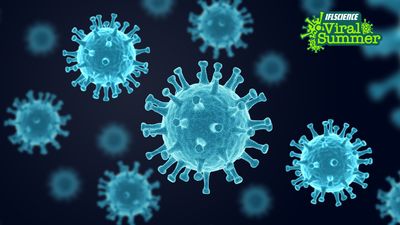
And yet, even these most basic of microscopic life forms are comparative novices compared to viruses. These are, by basically any measure, almost incomprehensibly successful: able to evolve on a dime, slipping through the defences of our immune systems and vaccines just as fast as we can create them; they can jump from host to host, even across species barriers; they can be frozen in permafrost for eons and come out the other side just as rambunctious as they went in.
There’s really only one reason viruses aren’t considered the most successful life form of all time, and it’s this: they’re not, actually, life forms at all.
Viruses: companion, enemy, helper?
Humans are creatures of analogies, which can make explaining viruses very difficult. They’re tiny – too tiny to envision, really, but as a rough guide: the coronavirus, which is not particularly small as viruses go, is approximately one-125,000th the width of your pinky fingernail. If you had that many humans standing next to each other, they would stretch most of the way across the Panama Canal.
They’re also far more numerous than our brains can really handle. “The estimates for the number of viruses on the planet are like, more than there are stars in the universe,” says Zamin Iqbal, Professor of algorithmic and microbial genomics at the University of Bath. “Which is madness, right?”
They do cause pain and suffering and heartache, of course, and viruses can kill you. But without their action driving biogeochemical cycles, we'd all be dead anyway.
Prof Mike Allen
But by far the least intuitive aspect of viruses is – well, just what they are. Not animals; not even bacteria or single-celled organisms like an amoeba. They’re unlike anything we’re familiar with, right down to the genetic level: “Viruses probably precede the cell,” explains Mike Allen, Associate Professor of Single Cell Genomics at the University of Exeter. “Their genetic information is coded on ss [single-strand] RNA, ds [double-strand] RNA, dsDNA, ssDNA […] whereas us 'living things' only have dsDNA.”
“Early on in evolution, dsDNA 'won' out over other forms for replicating, hence why the world is now dominated by dsDNA organisms,” Allen tells IFLScience. “But the viruses are relics of the early days.”
Today, five years out from a pandemic that infected about one in 10 people around the world and killed about 1 percent of those – and that’s just the cases we know about – it’s tempting to think of viruses as the enemy. That’s not entirely unreasonable: about 200 viruses do infect humans, after all. But “most viruses don't infect humans,” explains Iqbal. “There are probably more viruses infecting bacteria than infecting mammals.”
But rather than long-time adversaries, viruses are more like our fellow travelers through the tree of life. And they haven’t just held our hand through the eons of evolution – they have, in some cases, yanked us forward: viruses “are required by […] dsDNA organisms to help their evolution,” Allen points out.
Indeed, our own genomes, like that of probably any animal, are crammed with fossilized scraps of viruses that fundamentally changed the path of our species. They potentially gave us placentas, for example; they rewired the brain into its peculiarly human setup. Ironically, they even gave us the use of the gene that stops viral infections from spreading throughout the body.
“Most people think viruses are bad because we are obsessed with human disease caused by them,” Allen says. “They do cause pain and suffering and heartache, of course, and viruses can kill you. But without their action driving biogeochemical cycles, we'd all be dead anyway.”
The living dead: zombies or Schrödinger's viruses?
Given how entwined viruses are with the story of life as we know it, it’s perhaps surprising to hear that they aren’t considered life forms themselves. “Viruses aren't alive,” Iqbal tells IFLScience, “because they're not autonomous. They need something to live in.”
“But I mean, there are bacteria that need to live inside a human cell,” he adds. “[And] humans can’t survive without stuff to eat, or air, or a planet to live on.”
Time and again, the question of whether viruses are truly “alive” runs up against precisely this type of quandary. Where, if anywhere, can a line be drawn between entities that are alive and those that are not, with no exceptions on either side? “Until you define the term ‘alive’ then it is tough to answer [whether viruses qualify],” says Allen. “[It’s] blurry.”
Most people interpret “alive” as meaning “metabolically active”, Allen says – that is: do they generate energy? And it’s true that viruses don’t fulfil that condition – except, that is, once they infect a cell, when they suddenly do. Some, it appears, don’t need a host at all, at least if you’re creative enough with your definitions: “some have been found to have photorepair mechanisms, for example,” Allen points out. “Blurry line.”
How else can we define “alive”, then? “Another criteria people use is having a ribosome to translate their genetic material into proteins,” Allen suggests. “Viruses don't have ribosomes.”
“But recently some have been found with them,” he adds. “Blurry line again.”
It’s not alive, [so] it can't die [but] you [can] blow up the head of a zombie [so] that it can't carry on and reproduce itself.
Prof Zamin Iqbal
Are viruses, then, sometimes alive, and sometimes not? After all, we talk about them “surviving” in permafrost or being “killed” by our immune system – concepts which only make sense if we envision them as being alive in some way, even if professional biologists might wince at the phrasing.
They’re self-replicating, so they can, in a sense, be “born”, and with each generation their genome has a chance of mutating, so they unquestionably undergo evolution. “Their evolutionary rates are much higher than in traditional living organisms,” Allen says, “because one virus can infect one cell and make thousands of copies of itself, each potentially harbouring a different mutation on which the environment selects.”
“They evolve quickly because the selection pressure on them is so incredibly high.”
Add to all that the overwhelming impact viruses have had on the story of life itself, and you get a picture that’s hard to square with the idea of a virus as something fundamentally non-alive. It’s why Iqbal suggests thinking of a virus as sort of like a zombie: not alive, but functioning; intent on turning those around it into copies of itself; “it’s not alive, [so] it can't die,” he tells IFLScience, but “you [can] blow up the head of a zombie [so] that it can't carry on and reproduce itself.”
Alive or not, does it matter?
Whether viruses are alive, or not, or some liminal state in between – that’s quite the conceptual brainteaser for you or me. But to biologists, it’s kind of the least interesting thing about them.
“I think people like to debate this because it draws attention to the field,” says Allen, “and that can only be a good thing at the end of the day.”
But “my response to this question is to simply say it doesn't matter,” he tells IFLScience. “[Viruses’] impact on the living world is bigger than any living organism's […] Does it matter if they tick all the boxes for what is and isn't alive?”
To a certain extent, asking whether viruses are alive is kind of like asking whether one complex number is bigger than another – it’s a question that only makes sense with a limited understanding of the ideas at play. “The original definition of life was of its time,” says Iqbal. “We started out thinking about life with animals, and then plants […] these definitions predate knowledge of microbes and evolution.”
These more simple versions of what are, in reality, much more complex concepts, are also how most of us first learn about “life”. We’re taught MRS GREN; we’re taught about survival of the fittest. We’re not so much taught about submicroscopic self-replicating particles that occasionally embed themselves within and thus reorganize the genome of entire species.
“A lot of how we think about everything is coloured by what we learn in schools, which completely makes sense,” says Iqbal. “And the way schools teach science and maths is, you teach a simplified version of things – you have to be incremental.”
“And that's fine,” he adds. “But it does mean every now and again you get cognitive dissonances between more sophisticated models, which we think are more true, and what we learn at school.”
As humans, we often crave clear categories – the kind that viruses and virology cannot provide. But as fundamental a question it may seem to non-experts, whether or not viruses are alive is one that doesn’t seem to bother those who work with them day-to-day.
Viruses, it seems, are far less a question of what is than they are what could be. “They are replicating genetic material. That genetic material can move around between viruses and hosts and knows no boundaries,” says Allen. “Maybe viruses can be regarded as the current location of dormant genes? Who knows. I really don't think it matters.”
“Think of the phrase ‘when the wise man points to the stars, only the fool looks at his finger’,” he tells IFLScience. “Life is beautiful and wonderful and full of diversity. Today's snapshot of diversity will be different to tomorrows and to what came before.”
“No gene is alive, but together they create ‘life’ […] and diversity comes from all the genes as a whole, regardless of where they currently are.”