Nature
 PUBLISHED
 1
1


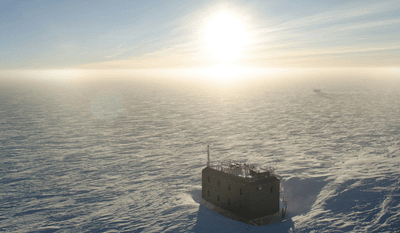


Antarctica's ice sheet formed millions of years before the Arctic froze over, at a time when Earth was around 50°C (90°F) warmer than it is today. A new theory suggests a surprising culprit behind this ancient deep freeze: continental breakups, churning currents deep in Earth's mantle, and the slow birth of mountains.
The vast East Antarctic Ice Sheet, the planet's oldest and largest ice mass, began forming roughly 34 million years ago. Scientists have long pinned its formation to dwindling CO2 levels in the atmosphere, which cooled the planet enough for ice to take hold.
However, this doesn’t quite add up. If falling CO2 alone were responsible, you'd expect both hemispheres to freeze over together, not just the southernmost continent around the South Pole, while the Arctic stayed ice-free for millions more years.
In a new study, researchers put forward the fresh idea that tectonic upheaval and continental uplift must have played a decisive role in Antarctica's early freeze.
“If falling levels of CO2 acted alone, you would expect the poles to respond more symmetrically. Instead, Antarctica gained a major head start because geological processes had raised land to higher elevations, making it colder,” Thomas Gernon, lead author and Professor of Earth Science at the University of Southampton in the UK, said in a statement.
Antarctica was made in a messy breakup
The team designed computer models to trace how shifting continents reshaped the landscape around Antarctica over roughly 100 million years. The trigger, they found, was the breakup of Antarctica and Africa during the Jurassic period, between 201 and 143 million years ago, as the supercontinent Gondwana tore apart.
That upset sent slow-moving ripples through Earth's mantle, dubbed "mantle waves," a phenomenon Gernon's team first identified while studying similarly strange high plateaus in southern Africa.
As these waves spread beneath East Antarctica, they gradually lifted the crust from below, raising a coastal escarpment, an elevated plateau, and the Gamburtsev Mountains, a mountain range now buried under more than a kilometer of ice in the depths of the continent.
By around 45 million years ago, much of the East Antarctic landscape had risen by roughly 1.5 to 2 kilometers (0.9 to 1.2 miles), above the threshold needed for snow and ice to survive year-round, allowing it to build into a permanent ice cap.
“We found that our models can realistically capture the evolution of the 2-kilometre-high coastal escarpment, elevated plateau and inland mountains, eventually seeding the East Antarctic Ice Sheet,” said Dr Thea Hincks, Senior Research Fellow at the University of Southampton, who co-led the study.
“Topography is fundamentally important for glaciation. Air temperatures can drop by up to 10°C for every 100 metres of altitude gained,” explained Dr Guy Paxman, co-author and Royal Society University Research Fellow at Durham University.
Geology calls the shots
The research is a reminder that plate tectonics is inextricably intertwined with Earth’s climate and, in turn, life.
Another classic example of this relationship is the end of the “Boring Billion”. Between 1.8 billion and 800 million years ago, Earth entered a long lull, marked by very little change in biological evolution, geology, climate, or the chemical composition of the ocean and atmosphere.
One of the big factors that overhauled this period of sluggish stagnation was the shifting of tectonic plates, which enriched the world's oceans by stirring up sediment and crust, releasing more nutrients into the water. The abundance of nutrients created a fertile environment that encouraged life and the evolution of more species.
Geology might seem like a slow, lifeless process, ticking along on timescales too vast to matter to anything living. But as this study shows, it’s often calling the shots in ways we’re only just understanding.
The study is published in the journal Science.