Nature
 PUBLISHED
 10
10


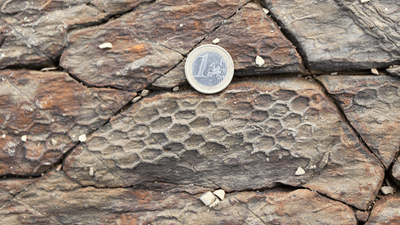


In 1850, Italian palaeontologist Guiseppe Meneghini named a fossil from Eocene-aged deposits. He wasn’t describing an animal, but a bizarre print left behind by an unidentified creature.
We have still yet to pin a firm identity on Paleodictyon, considered to be one of the ocean’s longest-running mysteries. Not only because it has eluded us for over 170 years, but because whatever it was, it’s been leaving its curiously honeycomb print on Earth for 500 million years.
Yes, Paleodictyon appears to be a kind of living fossil that has been occupying the deep sea from half a billion years ago to the modern era. Its range is expansive temporally, but it has also been found all over the world, too, from sedimentary rocks in the Alps to the depths of the Atlantic Ocean.
So, what is it?
Ichnology and ichnotaxonomy
Paleodictyon is what’s known as an ichnospecies. An animal known only from indirect evidence. The field of ichnology concerns itself not with physical remains but traces. Things like footprints, leaf prints, butt drags, and whatever the hell Paleodictyon is. You really can’t oversell the strangeness of these trace fossils because they appear like near-perfect honeycomb.
Its fossils are characterized by a net- or mesh-like sequence of hexagons. While hexagons aren’t all that rare in nature, being the favored geometric structure of bees and basalt alike, to find them so perfectly imprinted on the seafloor is.
You can understand, then, why scientists got so excited when, in the 1970s, scientists exploring an underwater mountain range called the Mid-Atlantic Ridge started noticing arrangements of small holes on the ocean floor.
Getting to meet a “living fossil”
It wasn’t until the turn of the millennium that we finally took a closer look to try and identify what they were. The ancient specimens identified by Meneghini were given the ichnospecies Paleodictyon strozzi, and these new specimens looked just like them. However, the extant examples are known to science as Paleodictyon nodosum. Unfortunately, getting a look at some modern examples didn’t yield many answers.
Several samples retrieved from depths of around 3,500 meters (11,500 feet) were found to be completely empty of any organisms, either living or dead. There weren’t even any traces of DNA remaining in its many criss-crossed tunnels.
It raises the as-of-yet unanswered question as to what kind of animal behavior – or body shape – could leave this kind of trace evidence behind. There are a few leading hypotheses.
The leading theories for what it is
One theory is that it could be some kind of worm-like critter creating a network of burrows. While yes, such a geometrically precise sequence is a little unusual, it could be an evolutionary benefit that makes it easier to trap food particles or channel water flow.
Another idea is that the imprint is reflective of the animal’s shape, which sounds crazy to us two-legged humans but is less bizarre in the context of the oceans’ deep-sea weirdos. A kind of single-celled organism known as Xenophyophores is one candidate, known to build elaborate structures on the seafloor. Perhaps Paleodictyon is what’s left behind of the body, or a cast of what its body looked like in life.
Some take that body theory further in applying it to some sort of unidentified sponge-like creature. It’s no secret that sea sponges can form epic structures (just look at the worm that lives in a “glass castle"), but we’ve so far been unable to back this up with any kind of DNA evidence.
Earth’s long-term residents
A maddening mystery for sure, but Paleodictyon is far from unique in having endured on Earth for such a long time. Jellyfish have been bobbing around for around the same amount of time. As have nautiluses, brachiopods, and sponges.
The incredible blue-blooded horseshoe crab has been scuttling around for 450 million years, but perhaps the ultimate underdog in the longevity battle is the silly-string-flinging velvet worm (much to the dismay of spiders, which arrived around 100 million years later).
Scientists continue to search for clues that could lift the honeycomb-meshed lid on what kind of creature is responsible for Paleodictyon. Until then, it remains one of palaeontology’s most fascinating and enduring deep-sea mysteries.