Nature
 PUBLISHED



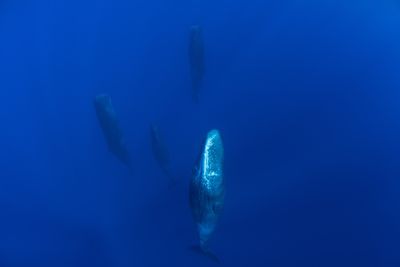


Hanging motionless in the vast blueness of the ocean, sleeping sperm whales look like they come from another planet.
Studies on dolphins and porpoises have shown that some cetaceans – the group that includes whales and dolphins – sleep with one side of their brain at a time, something known as unihemispheric sleep. This allows them to continue moving and breathing while underwater.
We think it likely that they are sleeping with both sides of their brain.
Patrick Miller
But less is known about how other, larger whales sleep. Some have been observed engaging in a motionless, drifting behavior, yet the sperm whale's habit of sleeping vertically with its head pointed to the surface is unique.
According to Professor Patrick Miller at the University of St Andrews in Scotland, this is due to their unusual heads.
“Sperm whales are named for their large ‘spermaceti’ oil that is located in their heads,” explained Miller to IFLScience.
“Because the oils are lighter (less dense) than other parts of the body, this causes sperm whales to passively rotate to the iconic head-up posture that we can see in photographs and observe using animal-attached tags.”
The secret of sperm whale sleep
The giant sperm whales can hang motionless in the water for up to 20 minutes at a time during these dives. But little is known about how they manage this, so Miller and his colleagues have been trying to find out.
“Because of how immobile and non-responsive sperm whales are during these resting dives, we think it likely that they are sleeping with both sides of their brain at a time,” says Miller.
But sleeping like this poses a problem. Even if the whale rises only slightly in the water column, the air in its lungs will expand as the pressure decreases. This causes it to rise a little more, creating a kind of feedback loop that would take it all the way to the surface.
So how do the whales stop this from happening?
By attaching little suction cups to the sides of 42 sperm whales living off the Norwegian coast, Miller and his colleagues were able to record not only the cetaceans' movements, but also the sounds they make.
Observing the eyes of the sperm whales during these dives could be another approach, as we’d expect one eye to remain open if they are sleeping uni-hemispherically.
Patrick Miller
The tags recorded the position of the whales in the water as they moved up and down, and they also captured the sound of the whales tooting gas through their blowholes.
It turns out that as they sleep, sperm whales vent gas up to 11 times per resting dive to maintain neutral buoyancy. This means that as they move towards the surface, they “quite regularly” release a little bit of air, which allows them to sink back down again.
Half asleep or deep asleep?
While this results in keeping the sperm whale stationary, Miller also points out that they might also be doing it to help regulate the amount of carbon dioxide that builds up while holding their breath.
How the whales are managing this while asleep is still unanswered. While Miller suspects the animals are sleeping with their full brain, this is something he’d like to investigate further.
“Ideally we’d love to see a technological breakthrough to enable us to measure their brain-wave activity, as that would be the best way to tell if sperm whales are sleeping uni-hemispherically or bi-hemispherically,” explained Miller.
“Observing the eyes of the sperm whales during these dives could be another approach, as we’d expect one eye to remain open if they are sleeping uni-hemispherically.”
If the whales are sleeping with their full brain, it would imply they have a passive ability to sense their depth in the water column and adjust themselves accordingly.
“Indeed, that is the fascinating question we have to ask after this study!” said Miller. “Are the sperm whales able cognitively to sense their depth and upward movement, and blow bubbles as needed, while fully asleep?”
“Because these sleeping dives only account for 7-10% of their time budget, they would benefit substantially by maximizing the time they are able to spend in full bi-hemispheric sleep.”
The results of the study have been published in the Journal of Experimental Biology.