Nature
 PUBLISHED


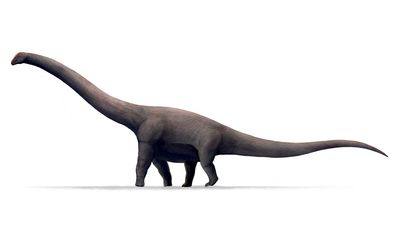


In 1978, palaeontologists digging in the Kallamedu Formation of southern India made a monumental discovery.
They unearthed the bones of a truly gigantic dinosaur, including a leg bone and bits of the animal’s pelvis. They were described as belonging to a titanosaur, a group of dinosaurs that included some of the largest animals ever to have existed.
Sometimes the bones are almost like the same consistency of a soggy biscuit, like a digestive biscuit.
Professor Paul Barrett
And this specimen was no different. It was estimated to have been the largest dinosaur ever to have walked the Earth, rivalling even blue whales in size. That was, however, until all known fossils of the animal were destroyed.
The biggest animal of all time
Formally described in 1987, Bruhathkayosaurus matleyi was originally thought to be a meat-eating dinosaur before being reclassified in 1995 as a type of sauropod dinosaur. These are your classic large, long-necked and long-tailed animals like Diplodocus and Brachiosaurus.
But when the size of the bones were compared to those of giant sauropods, it became apparent that this animal was something special.
Currently, the largest dinosaur known is Argentinosaurus, which likely measured up to 35 meters (115 feet) long and weighed up to maybe 80 tonnes. But the leg bone from Bruhathkayosaurus dwarfed even that.
Measuring in at a full 2 meters (6.5 feet) long, it was 29 percent longer than that of Argentinsaurus. Based on these measurements, scientists think that it could have reached up to 45 meters long and weighed up to 170 tonnes.
This extraordinary figure would mean that Bruhathkayosaurus would have been not only the largest dinosaur ever, but the largest animal of all time, beating even the blue whale.
Unfortunately, that’s as much as we’ll know. Not only after their discovery and description, the fossils of the dinosaur crumbled into dust.
How the fossils of the largest dinosaur were destroyed
It appears that the nature of the rocks in which the fossils formed is to blame. The formation is made up of a type of sandstone, which in the monsoon season soaks up lots of water. This in itself can cause massive problems when excavating bones.
“Sometimes the bones are almost like the same consistency of a soggy biscuit, like a digestive biscuit,” Professor Paul Barrett, a palaeontologist at the Natural History Museum, London, and world expert in sauropods, told IFLScience.
“It stays in shape up to a point, but as soon as you put any pressure on it, it just falls apart immediately.”
“It could be that when they exposed it, they could probably see what they had but as soon as you start to try and move or excavate material like that, unless you take a number of quite strong interventions, it just naturally disintegrates on its own and there’s not much you can do about it.”
The one thing that makes it slightly more complicated is that dinosaurs are obviously a lot larger on the whole than most living animals.
Professor Paul Barrett
With the remains from India, it seems that there was an added problem in that when the rocks then dry out, they contract and cause cracks to form. Reports suggest that by the time the bones made it to a lab, they had been reduced to rubble.
Intriguingly, these weren’t the first large dinosaur bones to have been found in this region. In 1862, a British meteorologist and palaeontologist called Henry Francis Blanford was working in India when he too came across large fossils in the Kallamedu Formation, and again in 1929 some more big bones were unearthed.
Unfortunately, it seems that these too crumbled. Since then, the remains of other titanosaurs have been found in the rocks, but mainly in the form of eggs. No other bones the size of the 1978 specimens have been found.
Estimating size from a bone
The size of Bruhathkayosaurus has been determined by looking at the measurements of the length and circumference taken before the bones disintegrated. This in itself is a little problematic, as obviously no one can go back and check the numbers.
But if they were accurate, according to Barrett they should give a fairly respectable estimate for the animal’s size, even with the necessary caveats.
But just how accurate are body size estimates for long-extinct dinosaurs?
“It’s fairly common these days to be able to base them on, say, a single leg bone, in particular a thigh bone, or if it's a quadrupedal dinosaur, maybe an arm bone as well,” explains Barrett. “There are now quite good mathematical models that relate the circumferences of limb bones to body mass.”
There are a bunch of physiological constraints that these animals will have that even if, say, the materials are capable of holding those weights up, eventually some of these other things to do with oxygen, food, blood pressure are going to just be insurmountable for an animal.
Professor Paul Barrett
“The one thing that makes it slightly more complicated is that dinosaurs are obviously a lot larger on the whole than most living animals. So it’s unclear how reliable that relationship is when you get to very big things, because there’s nothing alive today that we can use to ground truth those models.”
Just how big could dinosaurs get?
Estimating body size on a single bone is one thing, but whether that animal could have actually lived is another. Because while it might theoretically have been possible for sauropods to rival blue whales in mass based on the size of bones, physically there would have been other biological constraints.
One of these aspects is simply the mechanical strength of bones. Whether a leg bone is one meter long or two meters long, it is made of the same material, and so getting bigger doesn’t necessarily mean more strength.
This is especially true if you then start to consider the stresses that would be put upon the bones as an animal moved around its environment. Add on to that other aspects, such as how they would maintain blood pressure or regulate their temperature and things get even more complicated.
“There are other things you have to factor in,” explains Paul. “How do you get enough fuel for a body that size? These are animals that are going to have to basically eat continually just to have enough calories to tick over.”
“And that’s without thinking about issues like how do you get that much blood around a body? How do you get that much oxygen in to fuel that body and get waste out of it at the same time to stop you poisoning yourself? How do you stop yourself overheating when you're that big?”
“There are a bunch of physiological constraints that these animals will have that even if, say, the materials are capable of holding those weights up, eventually some of these other things to do with oxygen, food, blood pressure are going to just be insurmountable for an animal.”
Where that limit sits for a land-living animal is still not really known, and perhaps never will be.