Nature
 PUBLISHED




As a self-confessed bird nerd, I’m often left marveling at both the variety and breadth of the colors that can be found even in the feathers of the birds that visit my garden. Set your sights further afield than suburban England, however, and all manner of hues will be there to greet you.
And of all the bird species, is there anything more iconic and instantly recognizable than the perfect pink feathers of a flamingo? The glorious hue occurs naturally in the wild, but takes a little more effort to maintain in captivity, where hardworking zookeepers consider their diet carefully.
I posed the question to Tim Savage, Section Manager of Birds at Whipsnade Zoo, and Amanda Ferguson, Diet Management Officer for both Whipsnade and ZSL London Zoo: If a flamingo's diet is key to their iconic coloring, could you potentially change its color to something else?
How do you decide what to feed 40 flamingos at the zoo?
AF: The most important thing is looking at what these animals would eat in the wild, their natural diet, [and] the nutritional composition of that diet. That gives us a really good idea about what the animals should be eating when we have them in managed care.
And of course, we've got a lot of information from all the keepers that have been at London and Whipsnade Zoo as well, and they've worked with different birds, they may have tried different diets. We bring all that together and then decide what kind of food items we want. We do some calculations to work out how much they need to eat depending on their metabolic rate, body size, and activity.
What needs to be introduced into their diet to make them that gorgeous pink color?
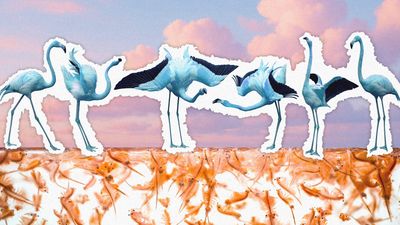
AF: In the wild, they are eating lots of little [brine] shrimp and microscopic algae, and all of those things contain a pigment inside them. And when the flamingos eat them, that gets transferred into the flamingos and [then] into their feathers. We have to feed them this bespoke pellet [with this] pigment, called canthaxanthin. It's a carotenoid pigment, and that's put into the pellet at the processing stage, and then when the flamingos eat it, they are actually ingesting that as well, and that's what helps keep their lovely pink color.
Carotenoids are a special group of substances. The colors that they generally give are kind of the red, yellow, orange kind of color, and that's the color that these natural organisms have inside them that then gets transferred into the flamingos, into their feathers, so they grow out with these beautiful red colored feathers.
Do they start off like this?
TS: When they hatch, they're covered in down to start with, which is a sort of gray/white color. And even as their feathers start coming through, they tend to be white to start with. And it takes them a good couple of years – in a few molts, where they lose their feathers and replace them – before they get this pink color. Interestingly, when pairs of flamingos are feeding chicks, because obviously they're passing a lot of that food over to their chicks, their feathers actually get sort of washed out. So they get a bit lighter. They're not as pink as they would be.
If the flamingos never ate this pigment, would they stay white their whole lives?
AF: They would be very pale, wouldn't they?
TS: They would probably be a very light pink color, certainly not the vibrant color they should be.
Hypothetically, if we were to inject a blue or purple chemical into their food, could we turn a flamingo blue?
AF: Well, this is where it gets really interesting, because we come into considering how a bird gets its color in its feathers. And there's lots of different ways, actually.
Blue and green are generally not produced by pigments. They're produced by the feathers having a certain structure, and the way that the light hits the feathers. And that's how you see all these lovely, vibrant blues and greens. So if you're thinking of the kingfisher with the blue, that's all to do with physics really, the physics of the light hitting the feathers and then bouncing off, and then we perceive just the blue color.
That doesn't happen with flamingos. And if you give any other dye or substance that's not a carotenoid, it will get broken down in the stomach and digested and metabolized. It doesn't ever get transferred into the feathers. If you feed it lots of green food coloring or blue food coloring, it won't make any difference to the bird at all, it will just get digested and [eventually] excreted.
This We Have Questions first appeared in Issue 45 (April 26) of our digital magazine CURIOUS. To access exclusive CURIOUS content first and receive the quarterly digital magazine, become an All Access Member.
Hungry for more CURIOUS questions? Head to the We Have Questions podcast for full-length audio versions of these curious conversations.