Nature
 PUBLISHED
 10
10


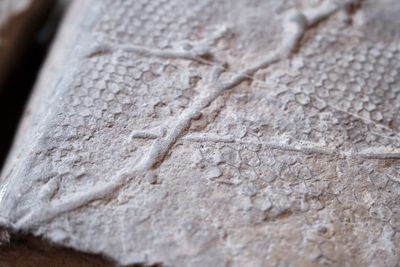


From the sandstone cliffs of continental Europe to the depths of the Atlantic Ocean, something has been leaving its dazzlingly geometric mark since the dawn of complex life. Despite finding thousands of these perfect honeycomb-shaped fossils, however, scientists are completely baffled as to what type of creature could possibly have been producing the patterns for such an unimaginably long time.
Amazingly, the earliest known record of these bizarre shapes can be found in Leonardo Da Vinci’s Paris Manuscript I. Amongst a series of sketches of marine fossils sits a drawing of a connected grid of perfect hexagons, which scientists later linked to an ancient creature called Paleodictyon nodosum.
The first physical traces of this enigmatic organism were discovered in sedimentary rocks that once sat at the bottom of an ocean during the Eocene, some 55 to 35 million years ago. Consisting of a net-like series of tunnels and shafts that link up to form honeycomb arrangements, P. nodosum has now been found in dried-up sediments across Europe, with the oldest specimens having been dated to the Cambrian Period, roughly 500 million years ago.
What scientists can’t figure out, however, is whether these prehistoric impressions are simply burrows made in the ancient seafloor by some bottom-dwelling creature, or an imprint of the organism itself. As if another layer of intrigue were required, researchers later made the mind-blowing discovery that the creator of these perfect patterns may still exist at the bottom of the Atlantic Ocean.
While exploring an underwater mountain range called the Mid-Atlantic Ridge in the 1970s, scientists started noticing arrangements of small holes in the ocean floor that looked very much like the hexagonal designs associated with Paleodictyon. It took until 2003, however, for researchers to finally look beneath the fine layer of dust and sediment that hid whatever was making the holes.
To their amazement, the researchers found honeycomb-shaped networks of subsurface tunnels that were identical to P. nodosum. However, after retrieving several samples from depths of around 3,500 meters (11,500 feet), scientists were frustrated to find that the hexagonal burrows were completely empty of any organisms, either living or dead. Even more infuriatingly, no traces of DNA could be detected within the tunnels.
What all this means is that we have absolutely no idea what is generating these mesmerizing patterns, which appear to have been in continual production for around 500 million years. We still don’t even know if the net-like arrangements are burrows or the imprint of some sponge-like creature.
With no option but to speculate, researchers have hypothesized that Paleodictyon may represent a cast left behind by organisms similar to glass sponges or giant, single-celled creatures known as xenophyophores. An alternative theory states that the networks are actually the remains of abandoned nests, and that the burrows are produced by hatchlings making their way through the sediment.
Yet another explanation posits that the underground burrows may represent a kind of "farm", built by some strange burrowing worm to trap and cultivate the bacteria it feeds on.
Ultimately, though, none of these hypotheses are free of holes, which means that whatever it is, Paleodictyon has us completely stumped.