Nature
 PUBLISHED




On the surface, the island of Guam looks like paradise. Beautiful, coconut tree-lined beaches, lush forest, and a glistening coral reef.
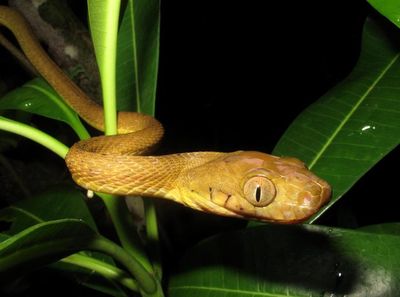
But the tropical idyll in the Pacific Ocean is overrun with invasive brown tree snakes. Accidentally introduced to Guam not long after World War II, the reptiles have been nothing short of disastrous for the island.
Reaching densities as high as 30,000 snakes per square mile, the voracious predators have caused the decline and extinction of a lot of the native wildlife.
But this explosion in population got researchers wondering how, from such a small founding number, they managed to do so well. Usually, this would cause something called a bottleneck, in which the limited genetic diversity of the original animals leads to inbreeding and the proliferation of harmful mutations.
A new study, however, has found that the reptiles have something of a hidden genetic diversity in the form of thousands of "genomic structural variants" that could explain their extremely successful introduction.
How did the brown tree snake cause so much damage?
With no natural predators and a forest filled with prey that have never experienced snakes before, the brown tree snakes went to town. Over the last 80 years, they have systematically emptied the forests of rats, shrews, bats, and lizards.
But it is the snakes' impact on the local bird population that has got most of the attention. Out of 14 species of terrestrial birds that lived in the forests on Guam (excluding, for example, the myriad of seabirds that visit the island), all but two have been driven to extinction.
This includes the Guam flycatcher. Endemic to the little island, it was known from no other place on Earth. The last sighting of the flycatcher occurred in 1983, just four years before it was realized what a devastating impact the snakes were having on the bird life.
Even when conservationists tried to protect nesting birds by building apparently snake-proof bird boxes, they found that the tree snakes could still access them by "lassoing" themselves. This was a type of snake locomotion never before recorded.
The impact of the snakes isn’t just limited to the wildlife.
When the snakes first appeared, they had a significant impact on people’s pets, while the sudden appearance of a venomous snake on the island was equally difficult for the local population to adjust to.
The propensity of the reptiles to climb up electricity poles has resulted in up to 200 blackouts per year. One study found that between 1991 and 1997, this cost Guam's economy up to $4.5 million annually.
Eight-legged victors
And yet, the dramatic reduction in birds and lizards has resulted in some beneficiaries.
While the forests of Guam are eerily silent of birdsong, they are teeming with spiders. Strung between trees, draped over branches, and built between the leaf litter are countless spider webs and their inhabitants.
There are hundreds of different types of spiders that live on the island, and since the introduction of the snakes, they have boomed.
It used to be quite normal for the spider numbers to go up and down with the seasons, but now on Guam every month is spider season. During the wetter months, there are now up to 40 times more spiders in Guam's forests than on the nearby islands of Rota, Tinian, and Saipan.
Even during the historically spider-heavy dry season, the numbers on Guam are still about 2.3 times higher. Even the size of some spider webs have grown, with the webs of the banana spider now 50 percent bigger.
Researchers think that, as the main predator of the eight-legged invertebrates was birds, as soon as the avian numbers dipped, the spiders took full advantage. In addition to the tens of thousands of snakes, the scientists now think there could be up to 733 million spiders.
Can brown tree snake genetics help save other species?
Bringing things back to the snakes, and it seems like the snakes' genetics have been arranged in such a way that individuals might have incredibly similar chunks of DNA, but just arranged in different orders.
“It’s like looking at portions of two books letter by letter with a magnifying glass and thinking they’re the same, but not realizing entire paragraphs have been moved around or duplicated,” explains Levi Gray, a postdoctoral researcher at the University of Buffalo and co-author of the paper, in a statement.
“Older sequencing technology didn’t allow us to easily see that DNA in one individual might be in a completely different place on the chromosome than in another. How we define genetic diversity and how we actually measure it is shaped largely by the technology of the day.”
This is super interesting, and could change how researchers think about genetic diversity and its impact on small, founding populations. This is of particular concern with highly endangered species.
For example, the California condor was reduced to just 20 individuals before conservationists were able to pull them back from the brink. Through extensive breeding programs, there are now over 600 of the birds in both captivity and the wild.
“It’s possible that endangered species may have more flexibility in their genes than we realize,” says Christopher Osborne, the first author of the paper at State University of New York Oswego, in a statement.
“We're now getting a better understanding of unappreciated sources of genetic diversity that may explain how some inbred species can still respond to their environment.”
The study is published in the journal Science Advances.