Nature
 PUBLISHED
 1
1


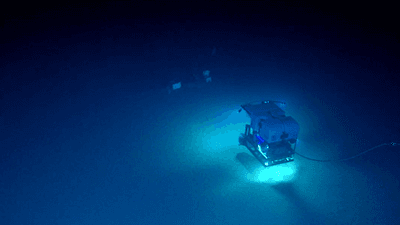


It’s not always smooth sailing in the life of an ocean scientist. Just ask the crew who directed a remote operated vehicle (ROV) to a suspected archaeological site in 2017.
Diving over 1,500 meters (nearly 5,000 feet) below the waves, they had been hoping a debris field spotted on sonar might lead them to a shipwreck. Instead, they found a gathering of washing machines.
The year was 2017. Salt Bae was leaving a trail of sodium across the globe as Despacito rang out on the radio, meanwhile scientists with the National Oceanic and Atmospheric Administration (NOAA) were gearing up for the Okeanos Explorer’s expedition headed to the Gulf of Mexico.
The first of three, the expedition aimed to establish a better understanding of the deep-sea environment in this part of the world. It lasted 23 days and was assisted by an ROV to get a good look at the seafloor.
With much on the agenda, they carved out time to investigate a sonar tip-off that appeared to show a debris field alongside a much larger object suspected to be a hull. A shipwreck? It's what deep-sea dreams are made of.
To quote the team, it was “truly a day of exploration as we send the ROV over to this unknown sonar target.” Oh, what that day had in store.
You can go along for the ride in a fantastic video aptly named “WRECK 15725: DEEP CLEAN”.
“I’d like to return this to the manufacturer and ask about the warranty.”
Admittedly, discovering a flock (herd? Washeteria?) of washing machines probably wasn’t the day of exploration the team had in mind, but there’s more to the story than a heap of deep-sea junk. A huge number of shipping containers are lost to the ocean each year as freighters battle intense storms on the open ocean.
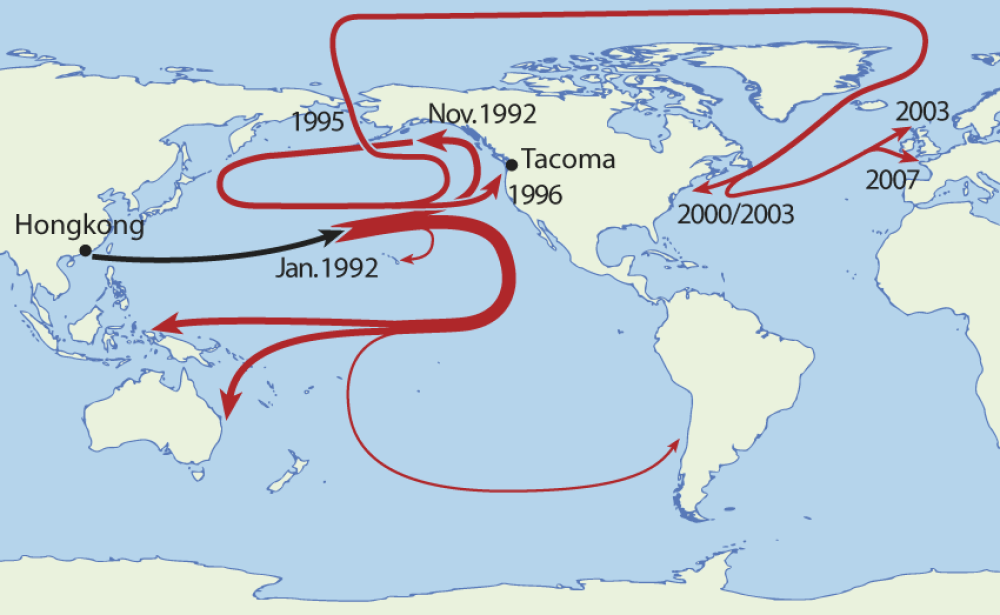
In fact, in 1992 one such spillage kick-started one of the largest and most unusual studies into global ocean currents when it unleashed 28,000 bath toys. The “Friendly Floatees,” as they would come to be known, first began to wash up on the Alaskan coast towards the end of 1992, approximately 3,200 kilometers (2,000 miles) from their point of origin.
A year went by and a further 400 followed suit, traveling to the eastern coast of the Gulf of Alaska. By 2007, bleached white by their journey but some still sporting “The First Years” branding that identified them, a small number began washing up on the southwestern shores of the UK.
It’s possible that there are still Friendly Floatees at sea to this day, whether caught up in one of the ocean’s great garbage patches or having washed up on shores where there are no people, or their significance is unknown. Having grown up on the south coast of England, I remain convinced I have one in my parent’s garage (but that’s a get rich quick scheme for another day).
NOAA’s sunken laundromat might not have taught us much about ocean currents, but as they pointed out, there’s plenty else we can learn from human’s lost property.
“While not the shipwreck we were expecting, the dive provided valuable information,” said NOAA. “Identification markings found on the container may help to track it, which could provide a maximum date as to when observed animals colonized these structures, allowing us to estimate growth rates of sessile organisms.”
“The dive also served as a reminder that, even in the deep ocean, humans can have an impact.”
Now if you'll excuse me, I'm off to figure out what the collective noun for a bunch of washing machines is.