Nature
 PUBLISHED


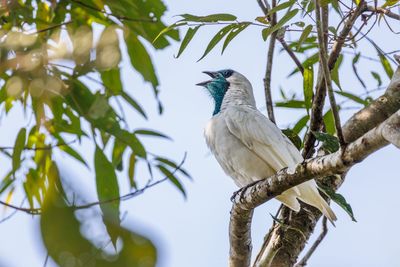


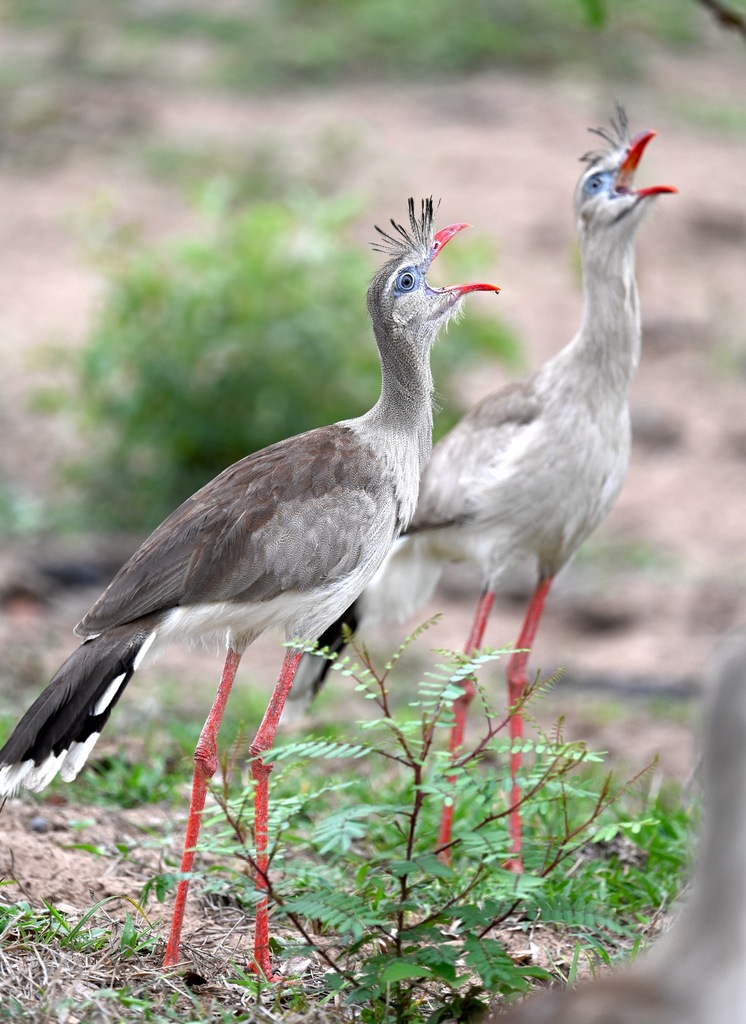
Cover your ears! There’s not one, but two new contenders for the world’s loudest bird. Meet the bare-throated bellbird and the red-legged seriema. While their calls might rival the current world record holders, the pair are also helping scientists understand why some birds are so much louder than others.
Measuring bird calls is no easy task – a squawk that might be painfully loud up close might not even be noticed by someone a few hundred meters away. Measuring both volume and distance is vital to get accurate recordings, but can be pretty impractical when working with wild species in the field.
“Figuring out how loud a bird call is should be pretty easy in the lab,” says João C.T. Menezes, who completed this research as part of graduate work at UMass Amherst in a statement. “But until very recently, it has been very challenging to do in the field, and there’s very little data to draw on.”
By using laser rangefinders more commonly found on a golf course and portable sound meters, the team was able to gather amplitude data for 123 species, 113 of which had never had their volume recorded before.
“We’ve been able to vastly increase the number of species for which there is amplitude data,” said co-author Jeff Podos. “This is basic, foundational research that no one else has managed to do on this scale, and it points to all sorts of other questions that would be fun to follow up.”
The results are pretty remarkable: the quietest species they found was a bird call from a hummingbird, just 64 decibels or about the same as a normal conversation. However, the bare-throated bellbird and red-legged seriema managed the loudest noises, topping out at 120 decibels to rival a jackhammer or chainsaw.
“[W]e found remarkable variation in maximum amplitude across the 123 species in our dataset, with a 58.3 dB difference between loudest and softest species,” explain the authors in the paper.
There were some similarities in the sound levels and the appearances of the birds – bigger birds with bulky muscles could produce louder noises, especially those with wider beak openings. This makes sense in evolutionary terms, since larger, stronger birds might be less likely to be predated upon and therefore can afford to advertise themselves.
It may also follow that birds with wider mouths and with polyamorous behaviors are louder, to advertise themselves to a wider range of potential mates by shouting the loudest.
“We now know some of the hows,” say Menezes. “Bigger bodies and wider beaks, but we’ve yet to discover the whys, and we probably need much more data from many more species to be able to tease out what’s going on the ecological and evolutionary front.”
However, the study points out that birds can produce sounds that exceed the decibel levels of species much larger than themselves, e.g. elephants, suggesting that there is more to be discovered about how these noises are produced and the evolutionary forces behind them.
“You can’t do this kind of work in the lab, or by scraping data from the internet,” concluded Podos.
You have to get out into the world, you have to pay careful attention to what you’re seeing and hearing, and anything you do in the field that forces you to observe more carefully is really fun – it takes you back to the roots of why we do science in the first place.”
The study is published in the journal Evolution.