Nature
 PUBLISHED


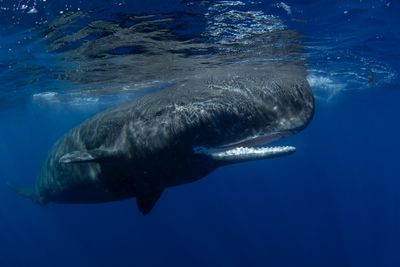


Sperm whales are famous for their loud vocalizations, which usually resemble clicks or even codas, and scientists have been trying to understand them for decades. New research has now revealed another class of sperm whale sounds, this time only made by the males: an extremely loud, low-frequency rhythmic call that can travel for up to 70 kilometers (44 miles) through the deep ocean.
The ocean's slowest drummers
Studying sperm whales (Physeter macrocephalus) in the waters off the Seychelles, Sri Lanka, Norway and Scotland, scientists found that the whales were making loud, low-frequency noises with long gaps of 5-10 seconds between each click, quite unlike either their echolocation clicks or the communication clicks previously studied.
What’s even more interesting is that despite the seconds between each noise, the whales were still keeping to a rhythm, albeit quite a slow one. One theory for how they manage to keep the rhythm is by listening to the echo of the click on the sea bed and using it as a signal for the next one.
“What is extreme about slow clicks is that the whales can produce them with long time intervals between them. And they can do it very rhythmically. And over those distances. It is really the combination of the three things that is extreme: the strength, the rhythm and the range,” said first author Simone Videsen, a postdoc at Aarhus University, in a statement.
The loudest thing in the ocean
The battle for the loudest animal on Earth takes place in the ocean. Sperm whale clicks have been recorded at an incredible 236 decibels underwater. However, if you're ready to immediately compare that to, say, a jet plane, we have to take into consideration that sound travels differently underwater, which means that 100 decibels (dB) in water is not the same thing as 100 dB in the air.
To make a more accurate comparison of decibels underwater versus decibels in air, we have to knock some decibels off the underwater value. Though there’s some debate about the best way to do this, it’s generally recommended to take 61.5 dB away – 25.5 to account for the difference in the reference pressure, and another 36 to account for the differences in density and speed of sound between air and water.
So, where does that leave the sperm whale? Well, convert 236 dB and you wind up with the equivalent 174.5 dB in air. That is equivalent to massive firework displays, high-powered rifles, Krakatoa erupting, and, according to the depths of the internet, Godzilla's roar.
How to honk if you're a whale
The whales are able to generate such noises because of what’s known as a nasal complex. This is a huge piece of whale anatomy and can be around one-third of the body length and weigh as much as five tonnes. This is also the anatomy that gives the sperm whale its name.
This complex contains phonetic lips inside the nose of the whale, which they snap together to create their clicks. The noises can even tell researchers about the individual whale’s nose and its health.
“A big nose sits on a big male, and a big nose will produce a lower-frequency click. That makes slow clicks interesting, because the clicks may tell us something about the male producing them. The sound may therefore function as an honest signal of size – what we biologists call honest advertisement,” explains Professor Peter Teglberg Madsen, senior author of the study.

By studying the clicks and then using sound models, the team thinks the clicks could be heard as far away as 70 kilometers (44 miles) from the whale making them. Factors like temperature, depth, and even background noise from human activity can all change the distance that the clicks are heard.
The sounds recorded during this study reached over 200 dB, making this the loudest communication signal ever recorded for a mammal. Now the team is hoping to work out why the whales are doing this.
Not their only unusual behavior
This isn't the only known unusual behavior from sperm whales. They appear to have a predilection for head-butting each other, and we don't know why they do this either.
They are also the only known whale to sleep vertically and we've only just discovered how they do it: by tooting gas.
The paper is published in Annals of the New York Academy of Sciences.