Nature
 PUBLISHED


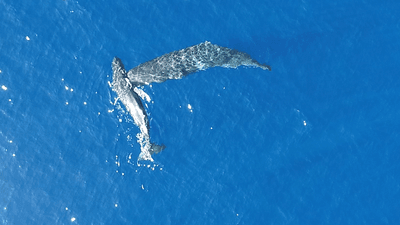


Whales make the news for lots of reasons: there’s international disagreements about whaling, research groups trying to decode whale language, and even some NSFW whale shenanigans happening in museums. The most recent cause of whale news, however, is that the sperm whales have been filmed headbutting each other. Why? We're not entirely sure but a team from the University of St Andrews has some ideas.
Captured by drone footage, sperm whales in the Azores and Balearic archipelagos can be seen literally swimming headfirst into the heads of other sperm whales. While this behavior was only really known from a few reported cases, true scientific observations have been pretty scarce. This marks the first time it has been caught on film and scientifically described.
Interestingly, this behavior has been reported anecdotally since the whaling industry of the 18th and 19th centuries, usually as a way to push and strike boats, and even inspired Herman Melville’s Moby Dick. Now, scientists have confirmed it.
The drones were actually launched between 2020 and 2022 to record blow samples or for body condition assessments, but in each case managed to record this unusual behavior.
In the first observation, two whales of the same size and a third whale were recorded by the drone. The third whale was not involved but did possess an acoustic tagger that recorded the sounds of the three whales to be combined with the drone footage. The two whales involved in the headbutting were swimming near the surface of the water and collided head-to-head, and then the head of whale 2 hit the body of whale 1.
The second example involved two males and a female, with the males diving under each other and coming up next to the female. One of the males headbutted the female in the top third of her body, nearer her head. The final example was two whales thought to be males of a similar size, involving several head-to-head collisions and head-to-body collisions.
All of these examples lead the team to believe that the whales are striking each other with a fair amount of force. It had previously been thought that these collisions were usually between large adult males, but the team thinks it could actually amount to “rough play” behaviors seen between young male sperm whales. The audio recording from the first example includes clicks and codas, which are whale noises typically associated with social contexts.
The rough play idea is also typically observed in juvenile whales to prepare them for adult competition for courtship and sexual behavior. The team also thinks that this could be a precursor to young male sperm whales leaving a group setting within the pod and starting their solitary adult life, especially if the headbutting is directed at females.
All the encounters occurred within two years of each other, soon after the drones started to be used in the fieldwork for other reasons. This suggests that the headbutting behavior could be considerably more common than first thought but difficulties in observing it without the use of drones have hindered reports. The team also wonders what other behaviours the drones might observe in the future.
“This unique overhead perspective for observing and documenting near-surface behaviour is just one of the ways drone technology is transforming the study of wildlife biology," said lead author Dr Alec Burlem in a statement seen by IFLScience.
"It’s exciting to think about what as-yet unseen behaviours we may soon uncover, as well how more headbutting observations may help us to shed light on the functions the behaviour may serve. If there are people out there with similar footage, we would be very keen to hear from them."
The paper is published in Marine Mammal Science.