Nature
 PUBLISHED


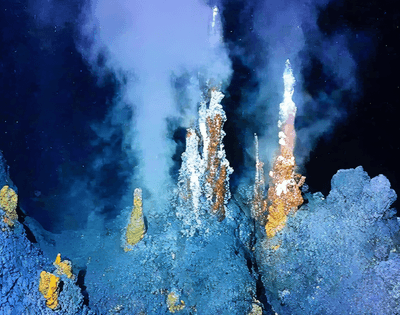


Scientists have witnessed the birth of new oceanic crust for the first time – an elusive process that spawned much of our planet’s current outer layer.
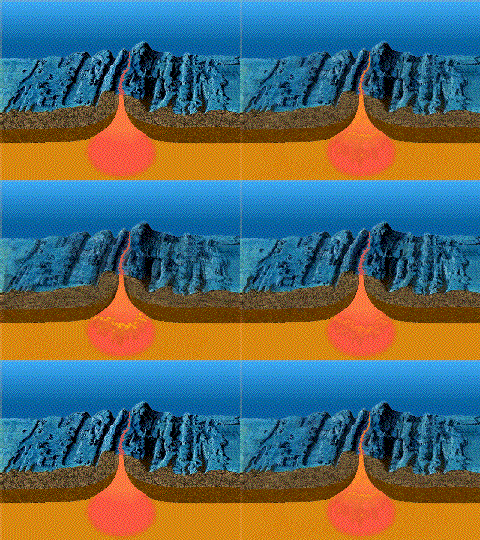
Based on movements detected deep beneath the sea, the team believes they've captured the first direct evidence of an Earth-shaping process in which the seafloor spreads apart, releasing a flood of magma from Earth's interior that rises to the planet’s surface. Once it reaches the cool seawater, it solidifies into freshly laid ocean crust.
French scientists recorded the momentous event using an autonomous observatory near Amsterdam Island, or Île Amsterdam, perched in the sticks of the Indian Ocean. This is the ideal place to witness a bunch of different geological wonders, as it sits close to the Southeast Indian Ridge, where the Australian and Antarctic plates meet.
Their observatory consists of five autonomous hydrophones (basically underwater microphones) that keep an ear to the seafloor, ready to collect seismic and other geophysical data. They were installed in late February 2024, and within just two months of running, they struck gold.
Getting ridgy with it
On April 26, 2024, the data showed a wave of earthquakes was rippling through the deep-sea region, causing the seafloor near the ridge to drop by 4.2 meters (nearly 14 feet) in a matter of days.
The team argues this movement was the result of a giant magma reservoir located 3.6 kilometers (2.2 miles) beneath the crust oozing its contents onto the seafloor, like a balloon deflating.
A major drop in seafloor occurred on April 26 between 9:03 pm and 9:40 pm, followed by a rise in water temperature, which suggests that hot lava may have reached the seafloor as early as 10:00 pm.
“Past that time, slower seafloor subsidence may reflect magma drainage through open fractures connecting the reservoir to the seafloor,” the paper reads.
This whole shebang is known as a seafloor spreading event, a burst of activity in which tectonic plates pull apart, releasing decades of pent-up strain through earthquakes, magma eruptions, and the formation of new crust.
Long suspected, but never directly observed
Scientists have strongly suspected this process unfolds for several reasons. For one, seafloor crust gets progressively older the farther you travel from a ridge, suggesting it emanates out from this central feature.
The seafloor is also decorated with geomagnetic “Zebra stripes”, indicating this movement occurred in multiple bursts over time.
However, it’s another thing to catch the unraveling in the act.
“Plate separation is continually forming new sea floor, but it has never been observed in situ — until now,” Ingo Grevemeyer and Lars Ruepke, two geophysicists at the GEOMAR Helmholtz Centre for Ocean Research Kiel, wrote in an accompanying News & Views article.
While impressed by the research, the experts added that there were some minor drawbacks to the study. They explained, “the seismic measurements identify where earthquakes occur, but not their depths. Therefore, deformation patterns in the crust remain elusive.”
“Another caveat is that the sea-floor topography measurements made before and after the event were based on deep-water echosounder data with limited lateral and vertical resolution. This introduces uncertainty in determining the magnitude of depth changes and how far they extend across the sea floor,” they added.
Nevertheless, the findings offer a rare window into a process that shapes our planet at a fundamental level. Two-thirds of Earth's surface has been created at mid-ocean ridges through a colossal churning process like this one, yet scientists still know remarkably little about how they behave during these hidden spreading events at the bottom of the sea.
The study is published in Nature.