Nature
 PUBLISHED





When was the last time you looked down a microscope? Well, if it's been a while, never fear. The winners of the Nikon Small World In Motion 2026 are here to showcase the best tiny things on this planet.
This year saw 347 video entries from 40 countries all competing for a chance to take home the crown. The videos showcase the best in microscopic video imagery, showcasing details that photography alone might miss.
Taking the top spot as this year's winner is Dr Ning Xu from China, for his video showing the cilia beating in an abnormal way in a child with primary ciliary dyskinesia, a rare genetic disorder that affects the respiratory system.
“Dr. Ning Xu’s winning video exemplifies why we introduced the video component of this competition 16 years ago: It allows us to use motion to transform our understanding of the microscopic world,” said Eric Flem, senior manager, communications and CRM at Nikon Instruments, in a statement sent to IFLScience.
“Xu’s work, and the work of all our winners, reflects the competition’s enduring purpose to inspire wonder, fuel discovery, and showcase the artistry inherent in scientific exploration.”
Second place in this year's competition was awarded to Nguyen Nam Nhat from Vietnam for his video of a tiny roundworm and a single-celled Dileptus that look like they hold hands, if they had them.
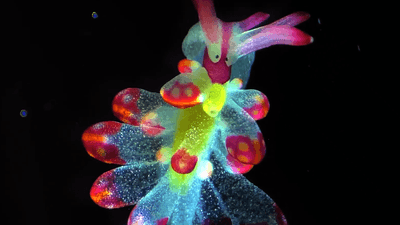
Other impressive entries include a tiny colorful sea slug filmed by Igor Adameyko from Vienna, Austria, that seems to have escaped from a private rave as it boogies around the screen. These sea slugs (Cyerce kikutarobabai) take on a green tinge thanks to the algae they digest.
Another honorable mention goes to something a little closer to home, as Cora A Harris recorded MSG salt crystals forming in drops of solution using polarized light. MSG is short for monosodium glutamate, and takes the physical form of white crystalline flakes that dissolve into food.
It can be found naturally in the form of glutamate in foods including tomatoes, mushrooms, and some cheeses. In the video, however, it simply looks beautiful.
Of course no microscopy competition would be complete without everyone's favorite microscopic creature: the tardigrade. In Benedikt Pleyer’s entry from Germany, the tiny creature can be seen walking around on snow, making up for the rather steamy scenes last time they were captured on camera.
“For over 50 years, Nikon Small World has repeated one simple message: science is beautiful,” Ning said. “And Small World in Motion has a second message that I'm even more passionate about: Life is not a still picture. Life moves.”
Established in 2011, Small World in Motion is the sister competition to the Small World Photomicrography Competition.
See the full gallery of winners here.