Nature
 PUBLISHED





Dogs are often called “man’s best friend”, but they earned that title through sycophantic means, sucking up to the strange hairless ape who tossed them scraps of meat from their campfire long, long ago.
It was a wise move for them to curry favor with hyper-competitive Homo sapiens, yet our species owes a lot to the dog’s less agreeable, often obnoxious rival: the cat. Unlike servile hounds, cats earned their god-like status on their own terms, which makes them an undeniably superior animal.
The cat doesn't always get the praise it deserves, but it doesn't beg for it either.
Once again, Shrek 2 got it right
William Burroughs once wrote: “The cat does not offer services. The cat offers itself.” It’s a great line, but it’s not strictly true – cats have provided a hugely important service to humanity for thousands of years.
The leading theory suggests cats became self-domesticated a little over 10,000 years ago in the Fertile Crescent of West Asia.
Humans had just started toying around with settled life and farming, which attracted mice and rats, which in turn brought disease. Wildcats moved in to hunt the rodents, starting a mutually beneficial relationship with people: the felines had a constant supply of fresh meals, and the humans got free pest control.
We also fell for a very sneaky trick, similar to the one played by Puss in Boots in Shrek 2.
Small wildcats are some of the most effective, prolific, and successful hunters on planet Earth, but they display something akin to neoteny – round faces and large eyes that make them irresistibly adorable to humans because they remind us of vulnerable, defenseless babies.
It’s the perfect disguise for an apex predator dressed up as something that needs caring for. At the very least, it convinced the Neolithic farmer not to kill the slinky kitten rummaging around their food supply.
The friendship begins
The ruse worked and, surprisingly quickly, a bond blossomed between the two unlikely allies. As early as 9,500 years ago, a human and a cat were buried together on the Mediterranean island of Cyprus, suggesting the person had kept the animal as a beloved pet.
Around 5,300 years ago, there is evidence of cats living alongside humans at an early agricultural village in central China. This is far from western Asia, suggesting that countless settlements and proto-cities along the way may have built a similar alliance with the small, self-cleaning mouser that had rocked up at their grain store.
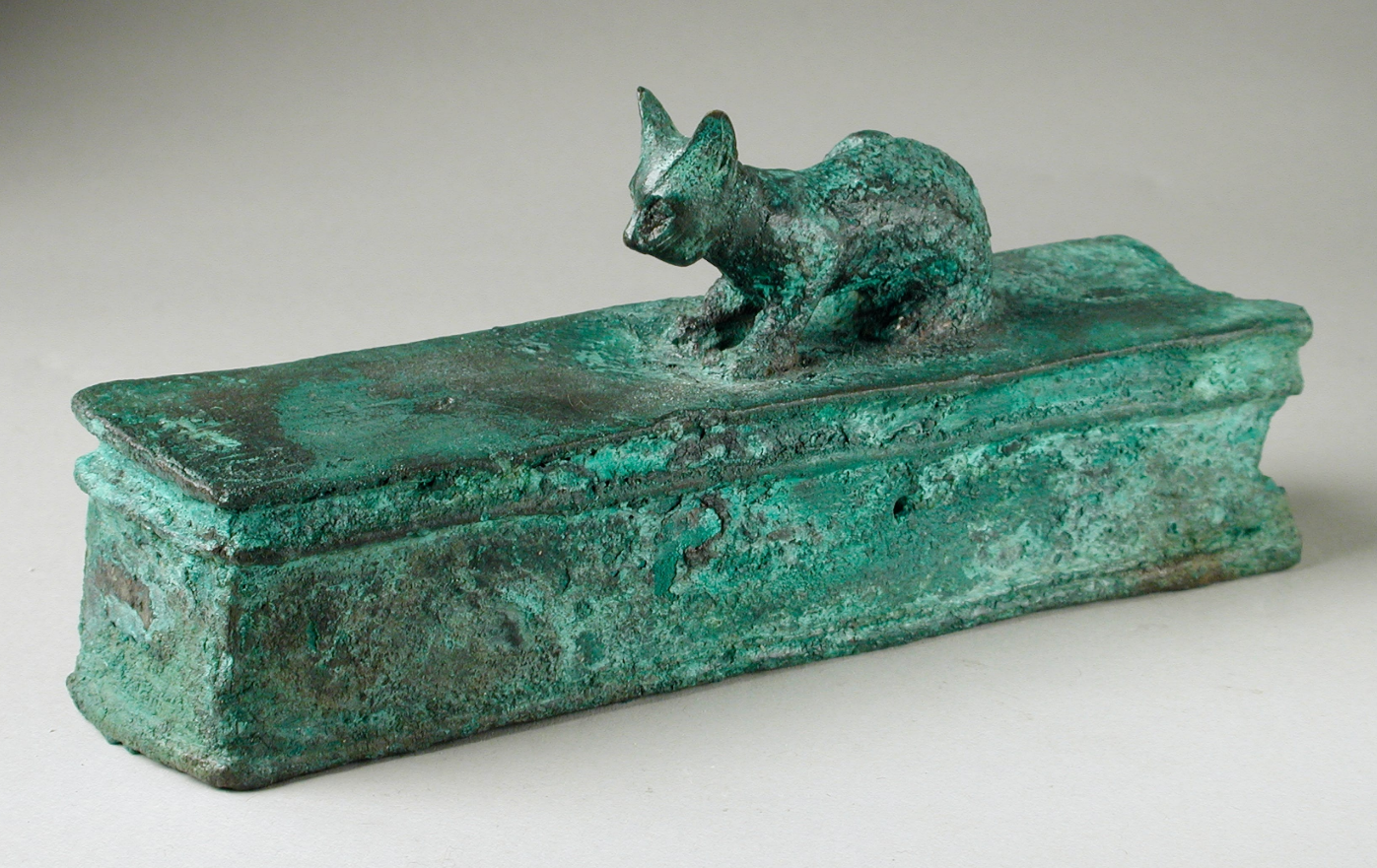
.jpg "Bronze lid of a cat sarcophagus from the Saite Period (Egypt, 664–525 BC)")
By 4,000 years ago, the ancient Egyptians used artworks and mummified remains to clearly tell the future that humans and cats had formed a bond like none other. Dogs were, quite rightly, also beloved by the ancient Egyptians, but they were treated as mere household companions, rather than mystical beings who were descended from the divine.
Humans have continued to diverge, develop, and digress over the millennia, but unbelievably little has changed for the cat since those first encounters in the Fertile Crescent.
The cat never sold out
Genetically, the modern moggy is scarcely distinguishable from its wildcat ancestor. So much so, some scientists have questioned whether cats can be considered fully domesticated or just “semi-domesticated”.
If you wanted to go wild, it wouldn't be impossible to make the case that cats domesticated us by allowing us to produce a surplus of food, eventually paving the way towards Dreamies (or Catisfactions as they are known across the Atlantic).
This is a very different story to dogs and their relationship with humans. The latest evidence suggests dogs split from wolf ancestors between 40,000 and 27,000 years ago, and these wild proto-dogs became domesticated in numerous places around Eurasia during the Ice Age between 30,000 and 18,000 years ago.
However, this process took a hell of a lot of work. To turn a wolf ancestor into a dog, generations upon generations had to be subjected to strong selective breeding. Aggression had to be weeded out, while pack loyalty had to be sculpted into blind obedience and dutifulness.
In some breeds – let’s say the pug and the Chihuahua – this change is plain to see, but with others – like the German shepherd or Siberian husky – it is not immediately visible. But make no mistake, they are still the product of immense compromise on behalf of the canine and intense effort from humans.
Cats, meanwhile, took one look at our grain stores, our rodent problem, and decided we were worth the investment. For reasons that are not always clear, they stuck around for the ride on the condition that we dare not change them too much.
Evolutionarily perfect?
Maybe the beautiful stasis of cats is an indication that the feline form is an elegant example of natural selection. Believe it or not, evolutionary biologists have made this claim, at least in jest.
Speaking to Scientific American, Anjali Goswami from the Natural History Museum in London playfully argued that cats are “perfect evolutionarily,” as shown by the fact that the broader feline family shows very little variation; it’s reached near-perfection, so there's no need to risk any change.
A pet cat, a cougar, a tiger, and a leopard all behave in extremely similar ways; they love to chase down prey, eat fresh meat, and lounge in the sun. They all stretch, yawn, and loaf around in a way that’s sometimes uncanny to watch.
It’s a design marvel (albeit without an active designer at hand). Like the iPhone, the years might bring subtle changes to its size, internal processing unit, or optical capabilities, but the essential format remains fundamentally unchanged because it works so seamlessly in the world it's born into.
This lack of feline variation is a significant contrast to most other charismatic mammals, Goswami argued, like bears, some of which are bamboo-munchers, some are apex predators, and some are fruit eaters.
Schrödinger's cat
Part of the reason cats often get second billing to dogs is that they're notoriously difficult to study and, as a result, are chronically understudied.
Researchers know surprisingly little about their cognitive abilities, their behavior, and sociability because they become easily freaked out in unusual lab conditions and refuse to cooperate with experimental rules.
Like a quantum phenomenon, they start acting weirdly the moment a scientist sets eyes on them.
In turn, they're often painted as simple, selfish, and uncaring. Perhaps if they were more slavish and fawning, they’d earn more favorable reviews.
In defense of dogs
In the interest of not receiving death threats to my inbox, it should be pointed out that I love dogs. I was raised alongside a beautiful golden retriever, and owe much of my microbiome to the amount I slept in her basket as a toddler and the slobber I encountered.
And yes, in a wartime situation, I'd take an aged Pomeranian over the healthiest housecat any day. The greyhound would take a bullet for you, but the ginger tabby would be off trading secrets with the enemy.
For transparency, I should also note that I am currently the servant of a house cat who frequently attacks my feet for no reason, steals food, destroys my sofa, and tortures smaller animals for sport.
But for all their sins, cats possess a set of high ideals that dogs could never muster: unflinching integrity, an alluring mystery, and the quiet confidence of a species that never had to audition for our affection.
IFLScience Hot Takes is a semi-satirical opinion column where we take a silly or outrageous idea and argue for it as if it's our earnestly held belief… as long as we can find good scientific reasons to back it up.
Do you agree with Tom? Or are you Team Dog all the way? Let us know!