Nature
 PUBLISHED





Animal behaviors can get pretty creative. Dolphins can come up with novel ways to hunt, a pair of sister raccoons created paper footballs to play with, and humpback whales even started smiling at boats.
Now one dolphin named Bubbles has been recorded harassing a species of fish so he can steal and eat their regurgitated dinner. Gross, yes, but more efficient than hunting for yourself? Debatable.
A menace and a crook
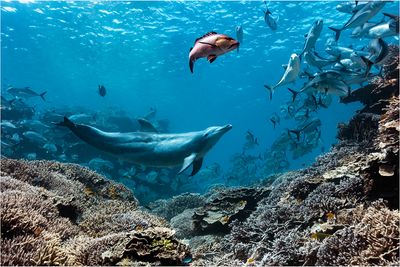
Off the coast of Lady Elliot Island in the Great Barrier Reef, Australia, lives Bubbles the bottlenose dolphin (Tursiops truncatus). But between 2021 and 2025 researchers caught Bubbles up to no good.
The team recorded 11 cases of what is called kleptoparasitism. This is when one animal steals prey from another predator, usually by harassing them until they drop what they've just caught.
In this case, however, one dolphin had developed a new strategy. Rather than chasing and catching its own fish, the dolphin took to harassing bigeye trevally fish until they regurgitated their own prey before swiftly consuming the vomit.
Using photo identification, the researchers were able to identify their criminal: Bubbles. It seemed he’d developed an entirely new – if unconventional – method to getting a meal.
Known to the island since 2017, Bubbles has now been observed chasing and interacting with the trevallies twice every month for about 4-5 days at a time.
“We observed him repeating this behaviour over several years which suggests he may have learnt to target the fish with the fullest bellies, providing the most rewarding meals,” co-author Dr Asia Haines said in a statement.
The MO of a vomit thief
The team classified Bubbles' behavior into different stages.
It starts with 'scanning', in which he picks a target fish, often one with a big belly, before progressing to 'targeting', whereby Bubbles then pursued the target fish, isolating it from the rest of the group. Then Bubbles engages in 'chasing', where he follows the fish at close proximity, and finally ends with 'ingestion', whereby Bubbles consumes the regurgitated food from the fish, and allows it to swim away unharmed.
“Common bottlenose dolphins tend to forage in groups, yet Bubbles was always observed foraging alone,” Romney Edwards-Francis, co-author and UniSC PhD student, said.
“It may be that this specialised tactic requires less energy than directly pursuing fast-moving prey, particularly when foraging solo.”
Following the ingestion process, Bubbles would then swim back to the school of trevallies and repeat the whole process again and again, as many as 10 times in 30 minutes. Delicious.
Bubbles is pretty picky with his targets though, and only goes for bigeye trevally and no other fish species.
The team thinks that Bubbles' unorthodox hunting technique might be more beneficial than foraging directly on smaller fish, which usually takes place in a group. Bubbles likely came up with this idea all on his own since no other dolphins have been observed doing it, and we wouldn't be surprised if embarrassment is preventing him from telling them.
The researchers suggest that Bubbles could even use echolocation to help identify a suitable target fish.
Dolphins are pretty resourceful though. In the UK, dolphins have developed a taste for octopus with surprising results, while another group is using shells to catch their fish, even teaching the young ones what to do.
The paper is published in Ecology and Evolution.