Nature
 PUBLISHED
 1
1


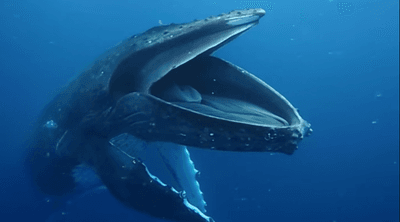


Tourists are helping scientists by documenting a rare humpback whale phenomenon whose function is not understood. Known as “gaping” it involves the whale opening its enormous mouth wide, even when there is no food for thousands of kilometers.
Like other baleen whales, humpbacks are capable of opening their mouths so wide they make the myth of Jonah being swallowed by a whale appear credible, until you learn how narrow their esophagus is. In their polar feeding grounds, they use this epic opening to take in vast amounts of krill or small fish in a single gulp, before forcing out the water they inevitably also swallow through their baleen.
However, humpbacks’ great migrations take them far from their food supply in a quest to breed, and it’s usually on these migrations that they are seen by tourists. Dr Vanessa Pirotta of Macquarie University and co-authors of a new study investigating this behavior first became aware of cases where whale-watchers were thrilled by the sight of humpbacks opening their mouths to maximum width. They sought video footage taken by soon-to-be citizen scientists of humpbacks “gaping”, ie opening their mouths when not feeding and far outside known feeding areas.
The behavior is certainly rare. If scientists had to rely on their own observations to investigate when and why humpbacks gape, they’d have nowhere near enough to go on. Fortunately, tourists and whale-watching guides find an open-mouthed whale so thrilling that they not only film it if they can, but also frequently put the footage on social media. That’s allowed Pirotta and co-authors to collect 66 examples they could locate and date.
“[I] can only imagine how amazing this would be for someone who has gone out whale watching expecting to see a few breaths and a breach,” Pirotta said to IFLScience.
With this data they hope to answer the question Pirotta posed to IFLScience: “Why would a whale decide to open its mouth without food? We assume it’s energetically expensive.”
Even more intriguingly, why does the gaping seem to be becoming more common?
Pirotta admits to some caution about the apparent increase in gaping. After all, humpback whale numbers are rebounding after whaling ceased, whale-watching is becoming more popular, and getting out the camera is probably more instinctive today than even a few years ago. It’s possible gaping has always occurred at similar rates, and we just lack the records.
However, the rise in frequency of reports appears to be too great to be accounted for by those factors, even in combination. It seems that if gaping is not entirely new, it is at least a fad for humpbacks.
Similar questions arise about the possible rise in bubble-net feeding and tread-water feeding, which involves opening the mouth similarly wide, but in the presence of fish that might swim in.
Moreover, Pirotta noted to IFLScience, it’s not as though one trend-setter humpback decided giving tourists a look at the inside of his or her mouth was fun, and others followed. “We’ve started seeing it in Tonga, Hawaii and off East Coast Australia,” Pirotta told IFLScience. “But we’re fairly sure the northern and southern hemisphere populations aren’t connected.”
The authors consider several explanations, without choosing a clear winner. “One theory is it is a form of communication,” Pirotta told IFLScience. “When it has been seen, it has always been in a social context.”
Pirotta can’t rule out the possibility that whales are putting on a show for us. “Whales do watch people on a boat, they’re very aware of the boat presence,” she said. Nevertheless, it feels a bit human-centric to think it’s all for our benefit.
The team hoped some details might help. A majority (36) of the incidents were filmed from boats, with the gaping occurring above the water line. However, the fact that 24 incidents were filmed by swimmers and involved the whales opening their mouths when fully submerged suggests this may be even more common, since it’s rarer that we have a chance to film it. The final six examples came from drones. Some of the underwater cases also included the whales clapping their mouths shut to produce sound.
In calves, gaping is sometimes accompanied by playful behavior such as flicking debris around. “Calves are sensory,” Pirotta noted to IFLScience. "They can’t use their hands, so if they are going to pick something up, it has to be with their mouths.” However, since no adults have been seen doing this, it’s probably not the sole reason for gaping.
Alternatively, it might just be that creatures that barely feed for months on end need to exercise their jaw muscles a bit to prevent them from atrophying.
One explanation Pirotta and co-authors can confidently reject is that the whales are yawning. Whales’ mouths are not connected to their lungs – to fight a carbon-dioxide build-up, they’d have to draw in extra oxygen through their blowholes.
Gray whales appear to open their mouths outside their feeding grounds more frequently than humpbacks, although Pirotta doesn’t know how many other great whales do the same thing. Still, it’s unlikely the northern humpbacks are copying their distant relatives, and the southern hemisphere branch of the family certainly can’t be.
“Just when we think we know a lot about humpback whales, we don’t,” Pirotta said in a statement. “Tourism operators and citizen scientists spend hours observing whales and are a powerful resource for capturing and reporting on behaviour, using the increasingly high-quality technologies many of us have on hand.”
The study is open access in Animal Behavior and Cognition.