Nature
 PUBLISHED




What you’ll discover in this article
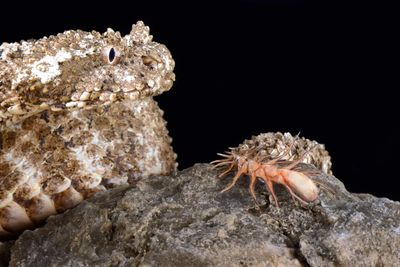
- The spider-tailed horned viper has evolved an extraordinary lure at the end of its tail, with a bulb-like end of long, drooping scales to imitate a spider.
- The snake was originally collected in 1968 but it wasn’t until 2006 that it was formally recognized as a distinct species.
- Sara Ruane, the curator of herpetology at the Field Museum in Chicago, told IFLScience “Pseudocerastes urarachnoides is one of the most bizarre examples of snake morphological evolution, because its tail has evolved to look and function remarkably like a spider.”
In the rugged mountains of Iran lives an amazing species of snake with a tail unlike anything seen in any other species.
At the end of the viper's tail is a chunky lure with elongated scales. As it sits and waits, it wiggles the lure in imitation of a large spider, hoping to catch the eye of its prey. Meet the spider-tailed horned viper.
How does evolution produce something that didn't previously exist?
Sara Ruane
“Pseudocerastes urarachnoides is one of the most bizarre examples of snake morphological evolution, because its tail has evolved to look and function remarkably like a spider,” Sara Ruane, Associate Curator of Herpetology at the Field Museum, Chicago, told IFLScience.
“Its tail ends in a bulbous structure with elongated, spider-leg-like scales. The snake can move its tail in a way that strongly resembles a spider crawling around and uses this to lure birds close enough to eat.”
Ruane and her colleagues have now finally been able to peer into the inner workings of this most unusual natural lure to try and figure out how it evolved.
The discovery of an incredible snake
The first specimen of the spider-tailed viper was actually collected in 1968, but the snake's unique ecology was not initially understood. At first, researchers thought the specimen might have been caught with a camel spider clamped on its tail, but further examination suggested that that unusual structure was some form of pathology, perhaps a deformity or tumor.
While I didn’t necessarily expect there to be bones in the spider appendage, I also thought the termination of the tail would be less typical.
Sara Ruane
For four decades it sat in the collections labeled as a different species, until in 2003 a second specimen was collected with an identical tail ornamentation. At the time, it still wasn’t fully understood how it was used, although the authors assumed that it was some form of lure to catch either mammals or birds.
“This appears to be the most elaborate morphological caudal ornamentation yet reported in a snake, with the possible exception of the rattles of Crotalus and Sistrurus,” wrote the authors formally describing the new species as P. urarachnoides in 2006.
It was then another couple of years before researchers finally captured the first footage of the snake using its lure in the wild.
This shows the viper sitting in little caves on rocky cliffs, extending its tail out into the open. It then twitches the lure in an extraordinarily convincing imitation of a spider, gaining the attention of an unfortunate bird. As the prey flies in to try and pick the spider off, it inadvertently becomes the meal itself.
But it is what’s going inside the lure that intrigued Ruane and her colleagues.
The spider-tail is an evolutionary novelty.
Sara Ruane
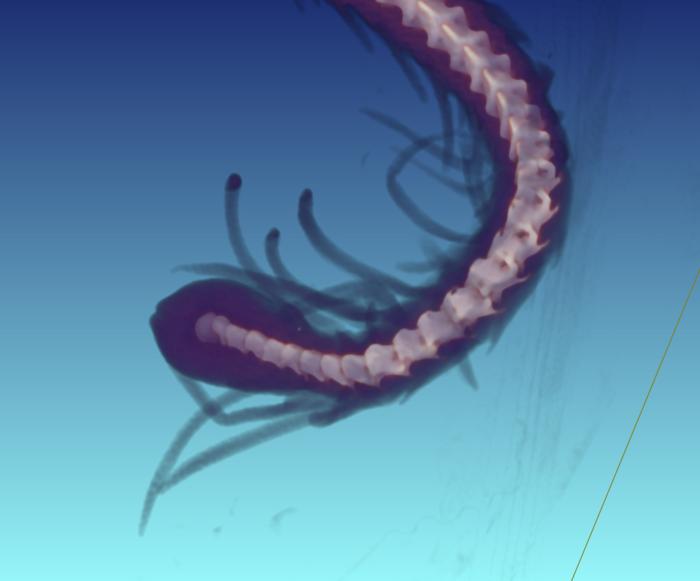
To figure this out once and for all, they put some of the snakes into CT scanners to peer beneath the skin and scales without damaging the actual specimens and they found… nothing.
“The tail ended just like any other typical snake tail, which was pretty surprising,” says Ruane. “While I didn’t necessarily expect there to be bones in the spider appendage, I also thought the termination of the tail would be less typical.”
The evolution of incredible morphologies
But, as with much of science even negative results are important. When it comes to the snakes and their unusual external morphology, the fact that the underlying structures are so familiar can tell us a lot.
“Studying unusual animals like this can reveal the developmental, genetic, morphological, and behavioral mechanisms that make novelty possible and we now have technologies, like CT scanning, that allow us to examine these animals in new ways,” explains Ruane.
“The spider-tail is an evolutionary novelty, where the structure is being repurposed for a new function. That connects to a much bigger question in evolutionary biology. How does evolution produce something that didn't previously exist?”
The tail can also help us understand how unusual traits can evolve without leaving any trace on the underlying skeleton. This can have implications for long-extinct creatures and how we recreate how they may have lived millions of years ago.
The study was published in the journal The Anatomical Record.