


 Nature
 PUBLISHED




The prehistoric continent Gondwana has often been belittled as a mere “large landmass”, but geologists have found new evidence that it was a supercontinent after all.
Gondwana: geology's underdog
Gondwana was a bundle of landmasses that dominated planet Earth about 550 million years ago until it broke apart around 180 million years ago, forming South America, Africa, Arabia, Madagascar, India, Australia, and Antarctica.
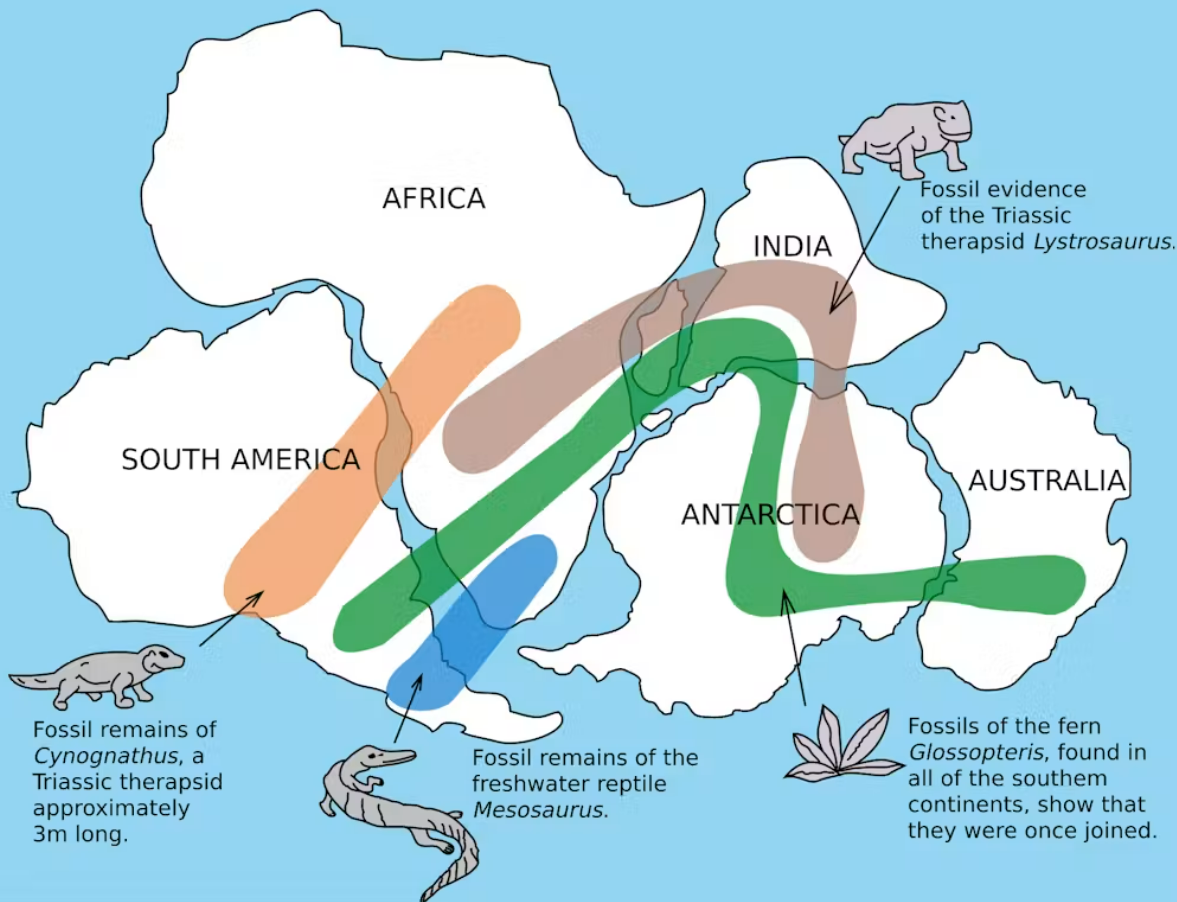
We know these modern-day continents were once connected thanks to similar fossils of prehistoric lifeforms, including dinosaurs, found in regions that are currently separated by thousands of kilometers of ocean (check out the map below).
If you look at the coasts of South America and Africa, you can see how these two continents once tightly hugged each other, like big spoon and little spoon.
Earlier projections suggested Gondwana made up around 64 percent of continental landmass in its prime – not quite high enough to obtain “supercontinent” status, according to some naysayers. However, a new study suggests we have been missing a major part of the story.
Geologists from the Chinese Academy of Geological Sciences and Curtin University in Australia have found evidence that large chunks of Gondwana are buried underneath Asia, Europe, and North America.
All hail Greater Gondwana
The discovery came about by chance, study co-author Bill Collins explains in an article for The Conversation. The team was collecting granite samples from around the world in a quest to understand how deep crustal processes relate to the formation of minerals.
While sifting through the data, they found that granites in parts of the Himalayas had formed at very different times in three bouts: 20 million years ago, 50 million years ago, and 120 million years ago.
Typical of granite, the rock had been formed through the melting of older continental rocks. In this case, they found that they all trace back to the same ancient continental block, one that formed 700 to 550 million years ago as Gondwana came into being.
Further investigation revealed other igneous rocks with a similar history – deeply buried, basement Precambrian crustal fragments – in parts of modern-day Kazakhstan, China, the mountains stretching from Europe to Asia, the mountains of Western Europe, and the Appalachian Mountains in the US.
Not all of this is sparkling new information, but the new paper provides a more precise, data-driven map of exactly how much buried Gondwanan crust is under today's surface geology.
It also massively uplifts the potential scale of Gondwana, the paper argues. Instead of making up 64 percent of continental landmass, the new analysis suggests it made up 80 percent of the global landmass at the time – enough to be classified as the “Greater Gondwana” supercontinent.
What the devil is a supercontinent?
Definitions of what makes a supercontinent are somewhat hazy, but several have existed in the distant past, including Pangea, Rodinia, and Columbia (aka Nuna).
Today, Earth has no supercontinent. The largest continent, the Afro-Eurasian landmass, contains about 57 percent of Earth's land area, which doesn’t cut the mustard.
But let's not get into how you define the planet's current set-up of continents…
The new study is published in the journal Science.


