Humans
 PUBLISHED




You're Robert Falcon Scott. You've spent over a year in the Antarctic, enduring hellish conditions and even eating your own ponies, only to be beaten to the pole in the final dash by a team of plucky Norwegians.
Dispirited and exhausted, you've battled through most of the grueling 800-mile return to base camp, but are now trapped by a blizzard just 11 miles from relative safety.
A little over a month ago, Edgar Evans was the first of your five-man crew to succumb to exhaustion and frostbite. A week back, Lawrence Oates voluntarily walked to his own death, hoping to hasten your return and relieve you of the burden of carrying him the rest of the way.
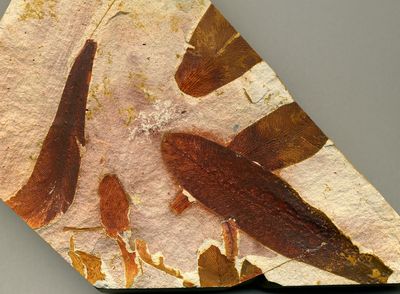
Now it's just you and your last two companions – chief scientist Edward Wilson and young Henry Bowers – holed up with your remaining supplies and, for some reason, a 16-kilogram (35-pound) bag of fossil leaves.
You don't know it, but when your bodies and equipment are recovered eight months from now, those curiously tongue-shaped fossils will begin their long journey to England, where they will make some palaeobotanists very happy indeed, and perhaps even help change our understanding of how Earth's continents came to be.
Seismic shift
First, some background. It may come as a surprise, but the theory of plate tectonics – describing how Earth's crust is broken up into plates that drift and grind against one another, floating atop a semi-liquid mantle – only came to be fully accepted in the 1960s, with the discovery of a phenomenon called seafloor spreading.
To put that into context, before we'd sussed out how continents move around, we'd already produced the atom bomb, mapped out the theories of quantum mechanics and relativity, and even (crash-) landed a human-made object on the Moon.
That isn't to say that people in the 60s were blindsided by the idea of plate tectonics. The concept and its earlier iterations had been accepted by some geologists for years beforehand, particularly in Europe. Still, it feels quite late to get that final confirmation, doesn't it?
As with much of science, it was a long and winding journey to understanding, the first steps of which were taken as far back as the 16th century. Then, intellectuals observed the complimentary shapes of the coastlines on either side of the Atlantic, which raised the possibility of some past connection between the continents.
One of the key thinkers on this was Austrian geologist Eduard Suess. In his book The Face of the Earth, published in 1885, he proposed that South America, India, Australia, and Antarctica had once formed a supercontinent connected by land bridges, but these had since sunk into the sea.
His reasoning was based heavily on the exact kind of fossil discovered in Scott's last camp in 1912. This plant, or more strictly its leaves (because palaeobotanists will give each part of a fossil plant its own name when they can't tell which bits belonged together), is called Glossopteris, and at that time it had been found in South America, Africa, and India.
In a pre-plate-tectonics world, that’s highly problematic, since Glossopteris bore seeds that were clearly too heavy to have floated across the oceans. Imagine the places it was found had once been connected, however, and that problem simply went away.
So key was this to Suess's thinking that he called his proposed southern supercontinent Gondwanaland, naming it after a district in India where a wealth of Glossopteris fossils had been found. The ancient landmass still bears that name today.
Back on the ice
Scott, it has to be said, wasn't especially on the lookout for these fossils, and it seems neither he nor Wilson knew what they were when they picked them up, other than tentatively noting their resemblance to English beech. It was merely chance that led to them being pocketed while the group rested their frostbitten feet for a half-day at Beardmore Glacier.
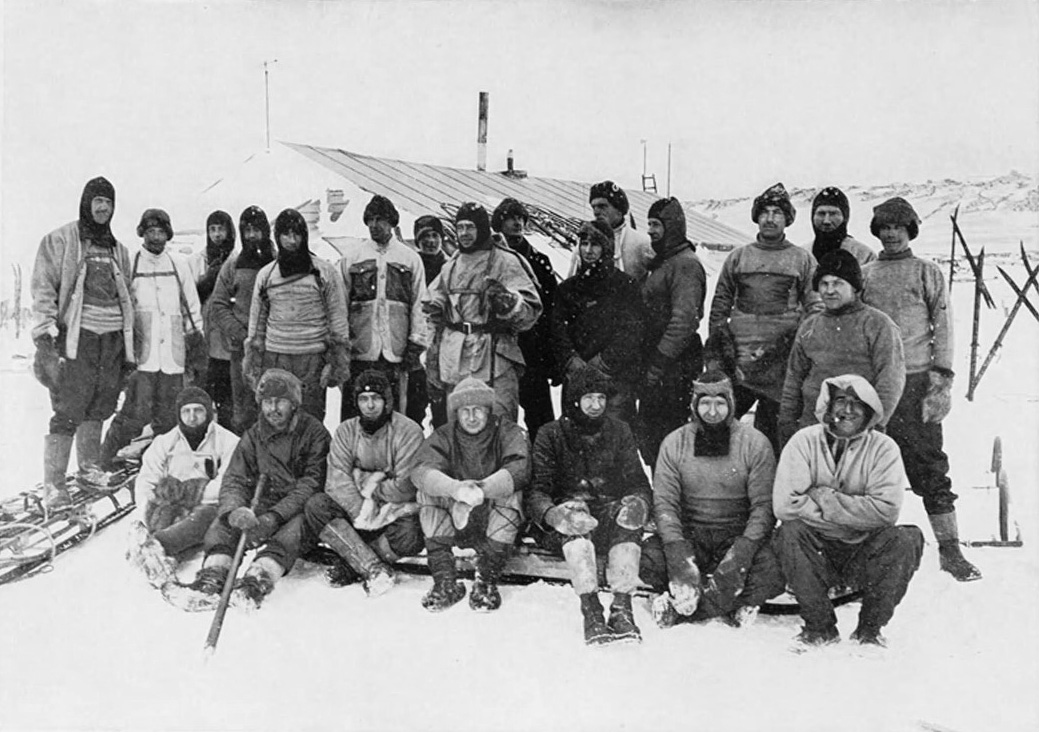
In his journal of February 7, 1912, Scott wrote: "I decided to camp and spend the rest of the day geologising… We found ourselves under perpendicular walls of Beacon sandstone, weathering rapidly and carrying veritable coal seams. From the last, Wilson, with his sharp eyes, has picked several pieces of coal with beautifully traced leaves in layers."
When the fossils were eventually recovered, researchers realized these were the first examples of Glossopteris from Antarctica, validating the concept of Gondwanaland and indicating that Antarctica had not always been the frozen wasteland it is today.
Frank Debenham, an Australian geographer who had taken part in earlier stages of the expedition and narrowly missed out on the poleward march due to, of all things, a football injury, noted that:
"The plant fossils collected by this party are the best preserved of any yet found in this quadrant of the Antarctic, and are of the character best suited to settle a long-standing controversy between geologists as to the nature of the former union between Antarctica and Australasia."
Bridges out, drifting in
In the same year that Scott died, German climatologist and geologist Alfred Wegener presented his displacement theory, or continental drift theory, to the public. This was subsequently published in a 1915 book called Entstehung der Kontinente und Ozeane (The Origins of Continents and Oceans).
Rather than land bridges, Wegener proposed that the continents had shifted in their relative positions over time, and they used to be much closer together.
He wasn't quite right about the how of it all, suggesting their movement had something to do with Earth contracting in size over geological time, but his idea of what was going on was right on the money, supported by a huge agglomeration of evidence, which he took from a wider base than Suess.
From geology, the Appalachian Mountains of eastern North America link with the Scottish Highlands, the rock strata of the Karroo in South Africa match the Santa Catarina system in Brazil, and the Brazil and Ghana mountain ranges agree over the Atlantic Ocean.
To that he added evidence from key fossils, including Glossopteris. One was Mesosaurus, a kind of reptile similar to a modern-day crocodile that lived during the Permian period. Its remains are found only in South Africa and eastern South America, and it wouldn't have had the capacity to cross the Atlantic Ocean.
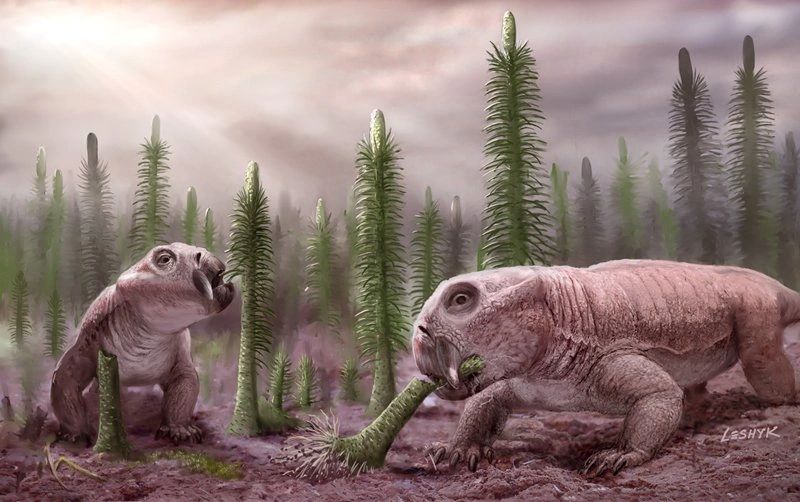
Likewise, Lystrosaurus, an extremely dominant land animal during the Triassic period, whose fossils have now been found in the Antarctic, India, and South Africa.
Glossopteris once again took on a starring role. Since the genus was a mainstay of the planet for many millions of years, it was possible to observe changes in the exact makeup and distribution of the fossils across the different continents over long periods, revealing that they were in sync with one another.
To Wegener, this was strong evidence that the continents were not only once connected, but that they were geographically closer together during the Permian than they are today, supporting his displacement idea over Suess's land bridge hypothesis.
Otherwise, he reasoned, it was hard to explain how disparate regions had experienced identical climatic conditions that led to the same things happening in the Glossopteris fossil record in places that are separated by huge distances today.
Notably absent from Wegener's writings, however, is any mention of Scott's expedition, or even of the existence of Glossopteris fossils in Antarctica. It's possible he didn't know about them, or perhaps he did but simply didn't incorporate them into his work because the discovery was so fresh.
Whatever the case, the lack of any mention of these hard-won fossils in the foundational text that gave rise to the concept of plate tectonics leaves the distinct possibility that, like Oates's self-sacrificial walk into the frozen wastes, this posthumous hurrah was also tragically futile.