Nature
 PUBLISHED



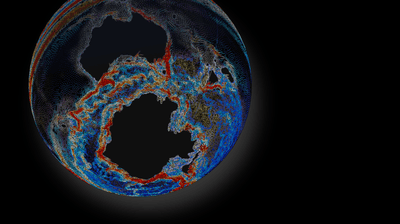


The Antarctic Circumpolar Current (ACC) – now the most powerful ocean current on the planet – got started around 34 million years ago. We used to think it was kicked off by tectonic movements that opened up space between continents, but new evidence suggests these were insufficient to form such a mighty underwater river on their own.
In the Southern Ocean, water roars westward around the Antarctic at about 4 kilometers per hour (2.5 miles per hour), endlessly circling the region. More than 100 times as much water is driven through this current than races to the sea in every river and stream on Earth combined.
The rapid movement forms a barrier, blocking the currents that bring warm water from the equator down the eastern coasts of the southern continents (and in one case the western coast).
Without the ACC, these warmer waters would lap at the coast of Antarctica, making parts of the frozen continent relatively temperate. We know because it used to be that way. The formation of the ACC initiated the Oligocene Epoch, cooling the entire planet relative to the previous few hundreds of millions of years.
Now, PhD student Hanna Knahl at the Alfred Wegener Institute in Germany and her colleagues have presented evidence that the ACC’s formation was more complex than previously thought.
As long as Gondwana – the supercontinent that lasted for hundreds of millions of years until the early Jurassic – existed, the ACC could not exist. During that time, any current running around Antarctica would have slammed into the landmasses that later became South America and Australia, diverting it north.
It was only when the Drake Passage widened and deepened enough to let a lot of water through – and Tasmania took off after the rest of northbound Australia like a faithful dog – that the ACC became possible.
Since these events were revealed, decades ago, climatologists had assumed that once the gates were open, the ACC immediately came rushing through. However, Knahl and her colleagues looked at the timing of the continental movements and proxy markers that show when the ACC formed. They found the initial current wasn’t like the ACC we know today.
“There were already indications that the wind in the Tasman Gateway played an important role in the formation of the ACC,” Knahl said in a statement. “Our simulations can clearly confirm this: Only when Australia had moved further away from Antarctica and the strong westerly winds blew directly through the Tasman Gateway, the current could fully develop.”
An initially weaker ACC wouldn’t be so surprising, but instead of a consistent current circling the globe, Knahl and her coauthors found the southern portions of the Atlantic and Indian Oceans had substantial currents once the Drake Passage reached half its current depth. Meanwhile, there was much less current in the southern part of the Pacific Ocean. This contradicts the expectation that the ACC is so strong because it has built up through endless looping.
The difference between the modern and early ACC is a product of the relationship between the straits the ACC could pass, the presence of an icesheet on eastern but not western Antarctica, and the location of wind belts.
Today it is driven by some of the planet’s most powerful winds, but the gales that flow from the Antarctic highlands down to the coast are also important. When only one side of the continent was covered in ice, the winds flowed differently, and even over the ocean they didn’t initially align with the space between continents.
Knahl is conducting the work to understand our future as well as our past. The ACC boosted the Southern Ocean’s absorption of carbon dioxide, so any modern changes could be very important.
“In order to predict the possible future climate, it is necessary to look into the past with simulations and data to understand our Earth in warmer and more CO2-rich climate states than today.” Knahl said, adding: “But careful, the climate of the past can of course not be projected 1:1 onto the future. Our study shows that the circumpolar current in its ‘infancy’ influenced the climate very differently than today’s fully developed ACC does.”
Besides CO2-absorption, the ACC shaped the climate planet-wide, even the distant Northern Hemisphere. Because once warm water could no longer reach the Antarctic, ice built up year on year, rather than melting in summer at lower altitudes and latitudes. This ice reflected more sunlight, cooling the region and eventually the planet.
This was, however, only one factor in the significant cooling Earth underwent around 34 million years ago. The formation and erosion of the Himalayas, Andes, and other mountain ranges drew vast quantities of carbon dioxide out of the atmosphere around the same time.
The study is published in Proceedings of the National Academy of Sciences.