Nature
 PUBLISHED
 7
7




Ancient ocean sediments have revealed the fluctuations in the strength of the Atlantic Circumpolar Current (ACC) over the last 5.3 million years. Comparisons with climatic conditions paint a complicated picture, but in more recent times, the current has been strongest when the Earth is at its hottest. Consequently, it’s no surprise that it’s happening again as humans exert our influence on global temperatures.
The ACC is the greatest conveyor of water on the planet by a vast margin, moving 100 times as much water as every river in the world combined. There’s a profound irony in the latest discovery, because the ACC is thought to be the main reason the Earth is so much cooler now than it was 35 million years ago.
Back then, Tasmania and Patagonia were closer to Antarctica and their presence impeded the development of a current that now eternally chases its tail around the southern continent. The ACC’s presence stops warm water from the tropics from reaching Antarctica’s shores and melting the ice in summer, which would warm the planet by reducing the reflection of light into space.
The ACC doesn’t need to be as strong as it is in order to perform that role, however, so having shaped the Earth’s climate, it is now shaped by it in turn. It has been noticeably speeding up in recent years, which has been attributed to faster winds in the screaming sixties, the ACC’s prime latitudes.
The direct cause of this acceleration is thought to be a 40 percent increase in wind strength over the Southern Ocean. What climatologists want to know is whether those stronger winds are caused by human-induced global warming, or something else. Recently evidence emerged that even the gravitational pull of Mars can influence the speed of the ACC, but something like that would only exert an influence over much longer timescales.
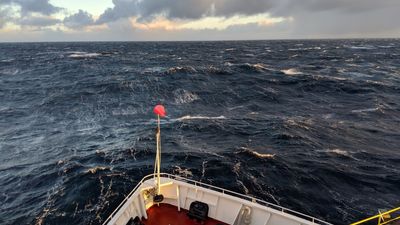
To answer the question, a team from a dozen countries investigated the ACC’s history using sediment cores from the deep ocean. These cores are not easy to collect; besides the challenge of drilling into the seabed when the ocean above it is kilometers deep, those driving winds make for some of the roughest waters on Earth. Nevertheless, climate scientists were up for the challenge, and from the research vessel JOIDES Resolution, managed to remove five cores in the South Pacific Ocean, beneath the ACC. Two of these were taken near Point Nemo, further from land than anywhere else on Earth.

When the ACC is slow, small particles dominate the sediment, but they get larger when it speeds up, providing a record of its speed over millions of years. Millions of years ago, the ACC strengthened as the world cooled down, but for the last 800,000, it has been strongest during warmer times. Ice Age speeds were as low as half the Holocene average, for example.
Current speeds are certainly not as fast as the ACC can go, if these cores are to be believed. Some past interglacial periods have been accompanied by speeds 80 percent faster than they are today, suggesting there is plenty of room for growth.

Despite the role the ACC has played in cooling the planet, you can have too much of a good thing. It is thought that the extra energy in a faster current can be transferred to ice at the continent’s edges, accelerating its melting.
"If you leave an ice cube out in the air, it takes quite a while to melt," study co-author Dr Gisela Winckler said in a statement. "If you put it in contact with warm water, it goes rapidly." Consequently, the association of warmth with a stronger ACC could be a case of each amplifying the other, at least to some extent, rather than a pure case of more heat driving a faster current.
The Atlantic Meridional Overturning Circulation (AMOC)’s slowing gets most of the attention, and is more likely to pose a threat to us in the short term, but the acceleration of the ACC could matter just as much in the long run.
The study is published in Nature.