Nature
 PUBLISHED




We live at a time in which it’s getting harder to find unexplored corners of our planet. The ocean remains ripe for discovery, as it’s estimated we’ve visually surveyed less than 0.001 percent of the deep ocean.
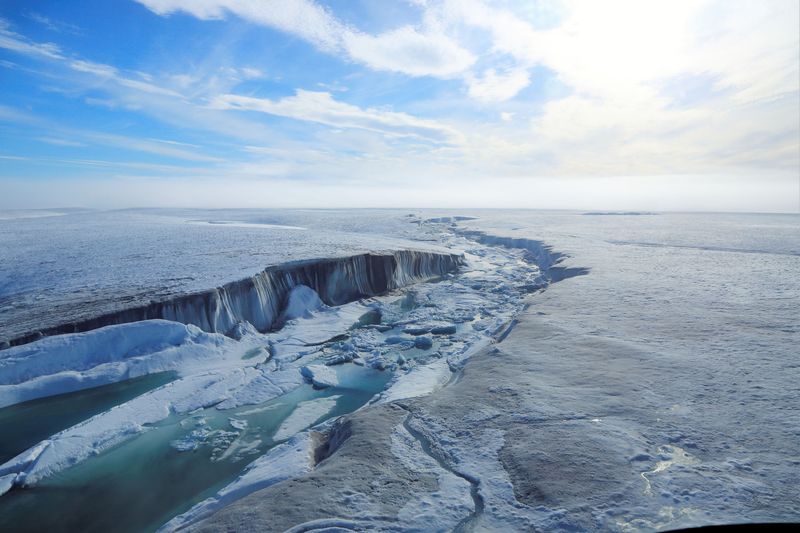
Some parts are hard to reach because they’re deep, others are covered by vast ice shelves, and some are a bit of both. That’s why it was with such anticipation that NASA drilled 183 meters (600 feet) into the Ross Ice Shelf in 2009.
Little did they know that they would be met by another lifeform at the bottom of their massive borehole.
Drilling into Antarctica
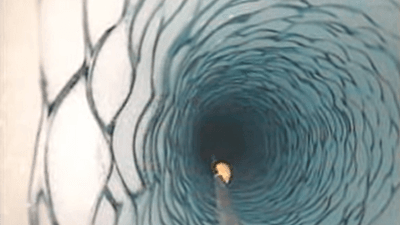
It wasn’t the first time humans had drilled deep into Antarctic ice shelves. In fact, that’s something we had already been doing for decades, but it was the first time we had sent a JPL-designed camera down to get a look at the ice shelf’s underbelly.
According to NASA ice scientist Robert Bindschadler, the team had been operating under the presumption that there wasn't going to be anything down there. Signs of microbial life, maybe, but certainly nothing zooming around in this place no light could reach.
Instead, they peered into the abyss and, as they say, the abyss peered back.
In this instance, that abyss took the form of a tiny but complex organism known as a lysianassid amphipod, a relative of shrimp.
“We were all huddled around the monitor just fascinated with what we were seeing at the bottom of our hole,” said Bindschadler to AP. “When I showed this to a marine biologist she was quite surprised because we are a long way from the open ocean, about 20 miles [32 kilometers], and this is a higher life form.”
“This is pretty far up the food chain and if it’s swimming around that means that there’s quite a lot of life at this location and that was a surprise to us because it was a surprise to them.”
"Meat-loving sea fleas"
These crustaceans are necrophages (aka, the “clean-up crew”) that will swoop in to feed on the carcasses of dead fish, seals, and penguins – though elsewhere on Earth, these “meat-loving sea fleas” have been known to nibble on living humans. Not just a complex organism, but a curious one, too.
“We had lots of questions in our mind, and it probably had lots of questions in its mind,” said Bindschadler. “It was extremely curious.”
What is interesting is where their food is coming from.
Prof Craig Stevens
“It was swimming around, sitting on the cable, looking at it from every angle, going up and down. I’m sure this was a very interesting day in the life of that amphipod, as it was for us.”
During that 2009 dip into the ice, the amphipod wasn’t the only sign of life. As the enormous cable was pulled back up, they saw evidence of jellyfish stuck to the metal.
Bindschadler described the ice shelf's underbelly as “an entirely new frontier for us to explore,” and explore we did.
Swarms of life
In 2022, researchers explored 500 meters (1,640 feet) below the surface of the ice – a few kilometers off the Ross Ice Shelf – and were met with swarms of amphipods as their probe plunged into an Antarctic river, one of many that sit beneath the continent's ice giants. Their existence in such numbers hinted at a hidden underwater ecosystem unlike anything seen in similar systems nearby.
“What is interesting is where their food is coming from and why their presence was so variable over the 10 days we observed,” said Professor Craig Stevens, a NIWA Physical Oceanographer, to IFLScience.
Perhaps a mere chip away at that 99.99 percent of deep ocean that still remains something of a mystery, but proof that big news can ride on the back of a tiny, curious crustacean.