Nature
 PUBLISHED


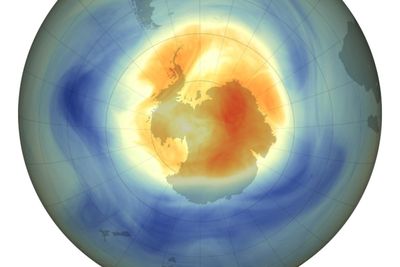


The Antarctic ozone hole in 2025 was one of the smallest in decades, and it’s all thanks to a concerted global effort unlike anything seen before or since.
A new report from the World Meteorological Organization (WMO) suggests the size of the hole in the ozone layer above Antarctica is significantly below the 1990–2010 average for the second consecutive year.
The ozone layer is a region of Earth’s stratosphere between 15 and 30 kilometers (9.3 to 18.6 miles) above the surface that’s rich in ozone. This thin layer of gas acts as an invisible shield that helps to absorb harmful ultraviolet rays from the Sun.
In the 1970s and '80s, scientists discovered there was a hole in the ozone layer above Antarctica. The hole grows and shrinks in waves that ride with the seasons, reaching its maximum size between mid-September and early October before closing again around late November or early December.
It turned out that the layer was being degraded by chlorofluorocarbons (CFCs) – synthetic gases once extensively used in aerosol sprays, solvents, and refrigerants. After wafting up into the stratosphere, CFCs release chlorine atoms that catalyze the breakdown of ozone molecules, creating a "hole" in the layer.
In a rare but welcome moment of unity, the world came together to solve this problem. In 1987, just two years after the publication of the ozone hole discovery, 197 countries and the European Union signed the Montreal Protocol, which saw the phase-out of CFCs.
It even included precautions that would allow the agreement to be flexible and ban ozone-depleting chemicals that were yet to be invented.
The latest update is another positive indication that the ozone hole is well on its way to recovery. The WMO ranked 2025's Antarctic ozone hole as the fourth to fifth smallest since signs of recurring shrinkage were first observed in 1992.
This is also the second consecutive year that the depth and extent of the hole was well below the 1990-2010 average.
“This is an environmental success story. Since 2000, the ozone layer has been recovering, and we can expect full recovery within several decades,” Celeste Saulo, WMO Secretary-General, said in a statement.
This echoes what Professor John Pyle, a leading atmospheric chemist and former Co-Director of the Centre for Atmospheric Science, who was instrumental in the Montreal Protocol, told IFLScience when we spoke to him for the 40th anniversary of the ozone hole's discovery last year.
“I think recovery by the second half of the century is reasonable, “ he told IFLScience.
“It's a slow process, recovery. It's slow because the lifetime of some of these gases is very long, and it's difficult to detect recovery because of interannual variability. But I think, by and large, the story is a good one."